














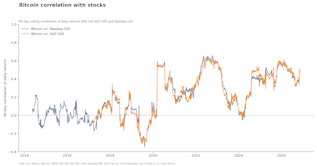
Bitcoin Correlation With Stocks: S&P 500 & Nasdaq Data


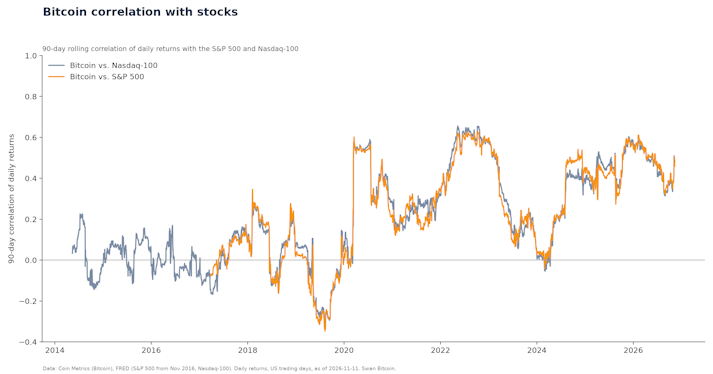
Bitcoin’s correlation with the S&P 500 was 0.42 in 2025 and 0.46 over the last 90 days (Nov 2026). Yearly data since 2017, Nasdaq, dollar and crash days.
In this article
BITO and GBTC both track Bitcoin’s price, but only GBTC holds Bitcoin. The ProShares Bitcoin ETF (BITO) holds Bitcoin futures contracts and charges 0.95% a year. The Grayscale Bitcoin Trust ETF (GBTC) holds Bitcoin and charges 1.5% a year, the highest fee of any U.S. spot Bitcoin ETF. Several spot funds now hold the same Bitcoin as GBTC for 0.14% to 0.25%. Figures below are as of November 2026. This is a comparison, not investment advice.
What it holds: BITO holds Bitcoin futures, not Bitcoin. GBTC holds Bitcoin.
Expense ratio: BITO 0.95%. GBTC 1.50%.
Net assets: BITO about $1.38 billion (ProShares, November 10, 2026). GBTC about $9.37 billion (StockAnalysis, November 11, 2026).
Bitcoin held: BITO none. GBTC 125,277.8 BTC (Bitbo, October 23, 2026).
Launched: BITO October 18, 2021. GBTC started as a private trust in 2013 and became an ETF on January 11, 2024.
Distributions: BITO pays monthly. GBTC pays none.
How closely it follows Bitcoin: GBTC follows Bitcoin’s price minus its fee. BITO follows Bitcoin futures prices, which can differ from Bitcoin’s price, and pays roll costs on top of its fee.
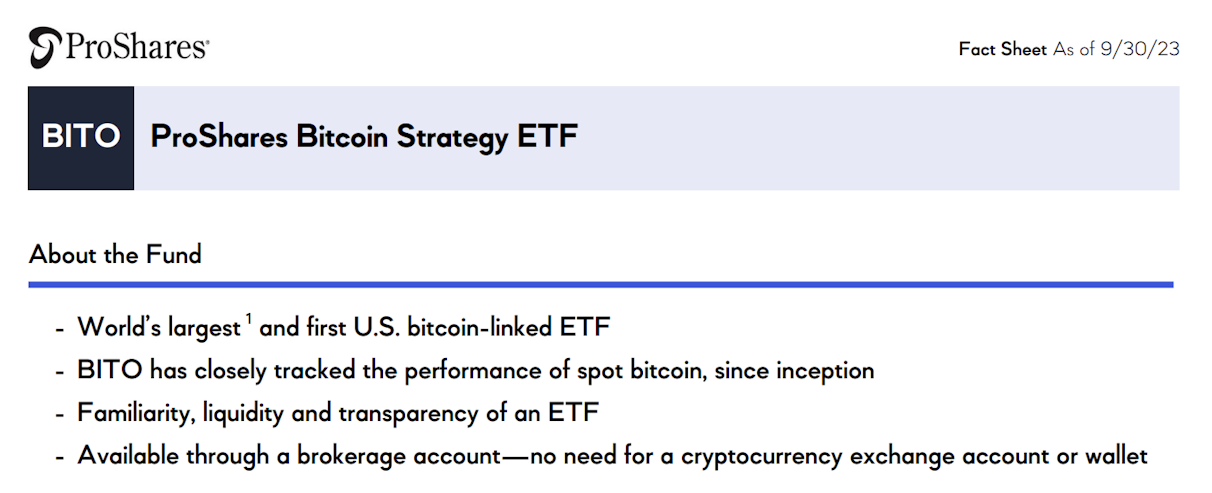
BITO is the ProShares Bitcoin ETF, an actively managed fund that buys Bitcoin futures instead of Bitcoin. It launched on October 18, 2021 as the ProShares Bitcoin Strategy ETF and was one of the first U.S. ETFs linked to Bitcoin futures. ProShares now lists it as the ProShares Bitcoin ETF.
On November 10, 2026, ProShares listed BITO’s holdings as:
79.28%: CME Bitcoin futures expiring November 27, 2026
16.00%: Coinbase Bitcoin futures expiring November 27, 2026
4.71%: a swap on the S&P CME Bitcoin Futures Daily Roll Index with Société Générale
The rest: cash and shares of the ProShares GENIUS Money Market ETF
ProShares
BITO’s average annual total returns at net asset value (NAV), as of October 31, 2026, according to ProShares:
1 year: −32.24%
3 years: 22.85%
5 years: −0.90%
Since launch (October 18, 2021): −0.72%
These figures include the monthly distributions. Past performance does not predict future results.
BITO’s 12-month yield was 28.64% as of September 30, 2026, and it pays a distribution every month. That number is not extra return on top of Bitcoin’s price. The payouts come out of the fund’s own value, which is why BITO’s one-year total return, distributions included, was −32.24% to October 31, 2026. Its SEC 30-day yield, which measures income the fund actually earned, was 0.68%.
ProShares reports how each payment splits between dividend income, capital gains and return of capital. Check that breakdown before you treat BITO’s payouts as income, because each part can be taxed differently in a taxable account.
A futures contract expires, so BITO has to sell each month’s contracts and buy later ones. This is called rolling. When later contracts cost more than the expiring ones, a market condition called contango, BITO sells low and buys high every month. That roll cost reduces returns, and it doesn’t appear in the 0.95% expense ratio.
The roll cost changes with the futures market: it is small when futures trade close to Bitcoin’s spot price and larger when they trade at a premium. A spot fund such as GBTC has no roll cost because it holds Bitcoin.
Bloomberg
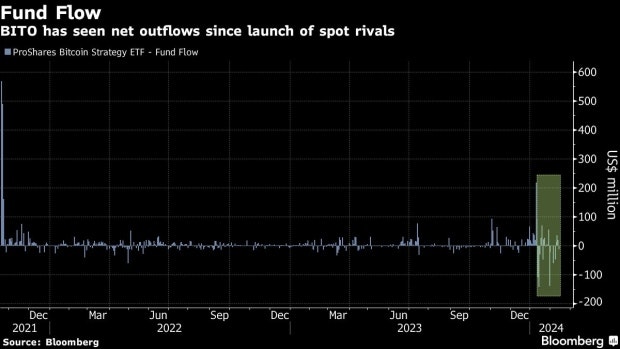
Until December 2023, BITO accounted for 92% of the trading volume among U.S. Bitcoin-linked ETFs, Bloomberg reported. After spot Bitcoin ETFs launched in January 2024, it saw net outflows (chart below). For the background on that shift, see what Bitcoin ETFs mean for you.
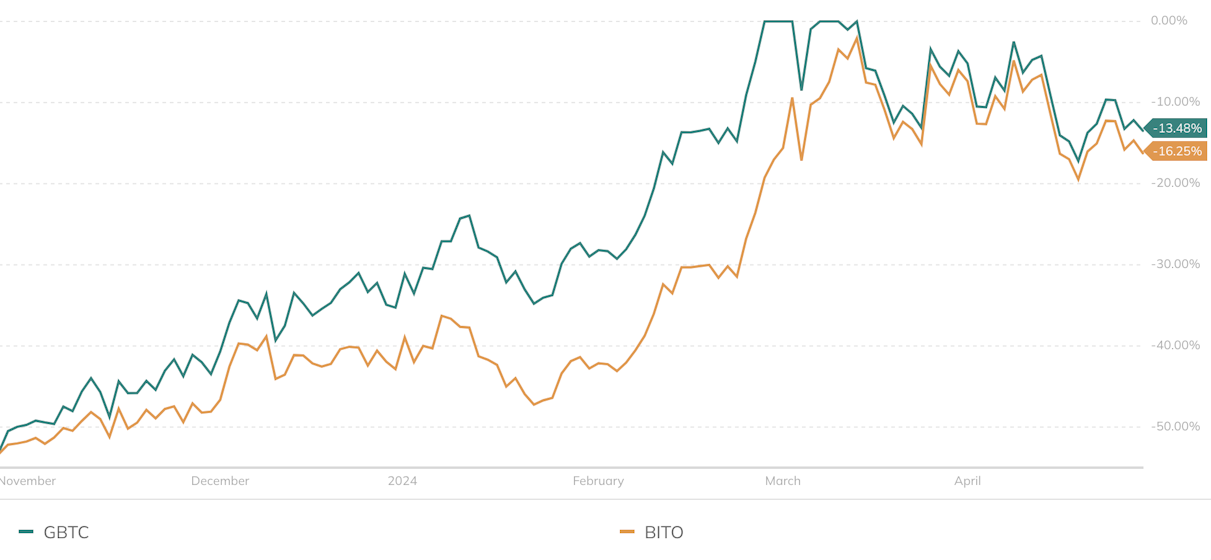
PortfoliosLab
GBTC is the Grayscale Bitcoin Trust ETF. It holds Bitcoin with Coinbase Custody, and its share price follows Bitcoin’s price minus a 1.5% yearly fee. It began in 2013 as a private trust that traded over the counter and became one of the first U.S. spot Bitcoin ETFs on January 11, 2024.
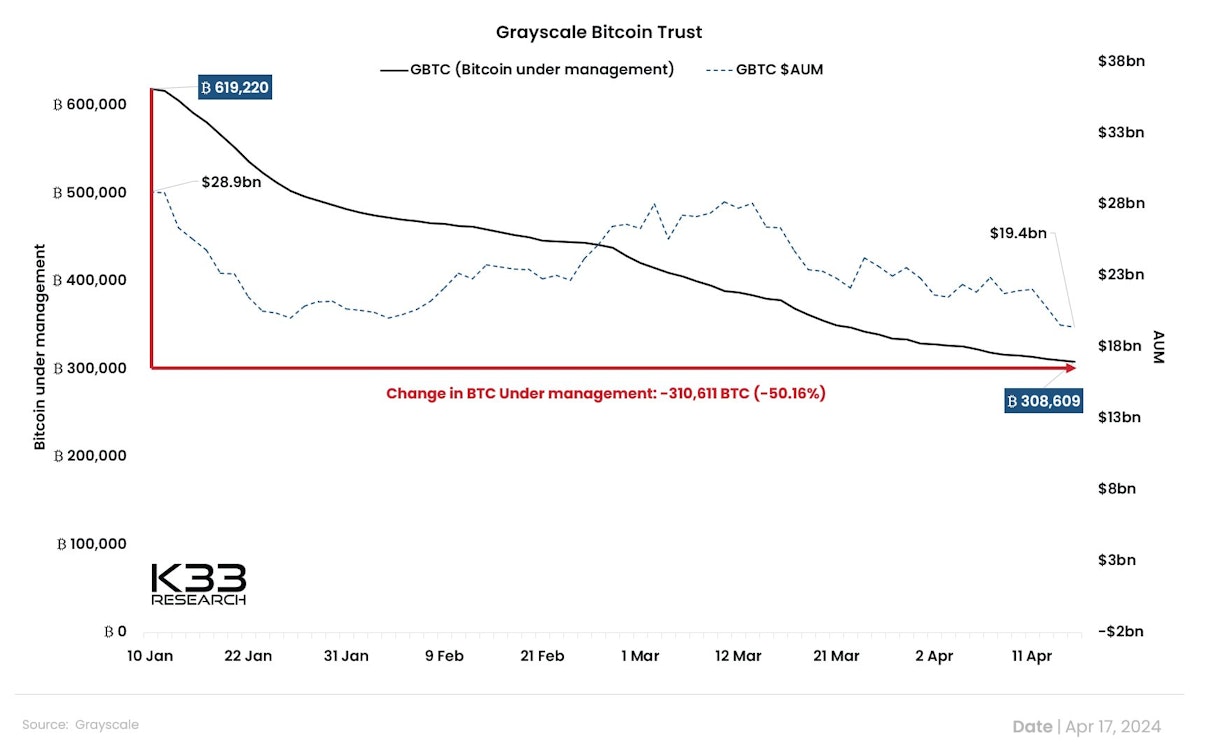
GBTC kept its 1.5% fee when it converted, while competitors launched at 0.25% or less. Investors left: GBTC held 619,220 BTC on January 10, 2024, and 125,277.8 BTC on October 23, 2026, a drop of about 80%. For the trust’s earlier history, see how GBTC was the genesis of the credit contagion.
K33 Research
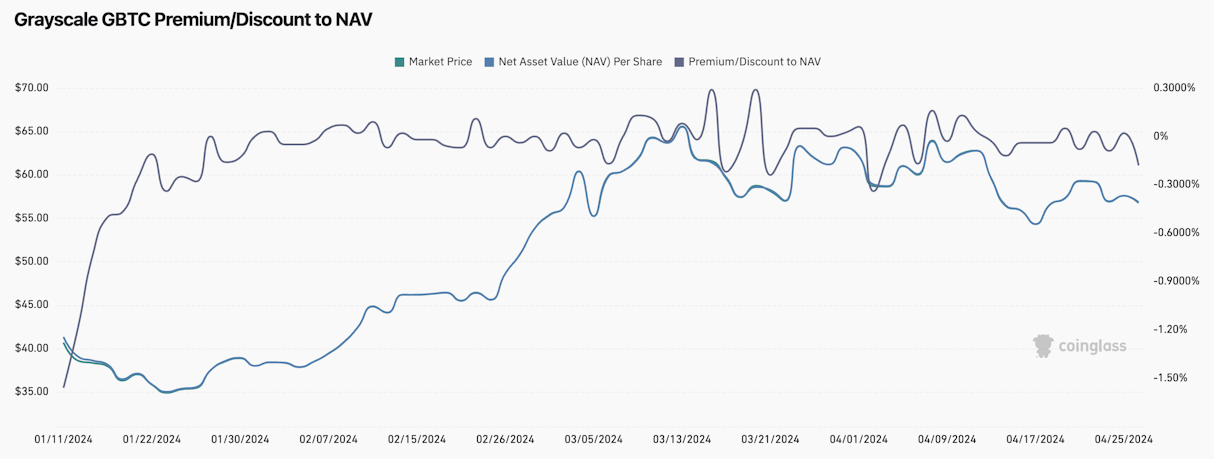
No, not in any meaningful way. Before 2024, GBTC was a closed trust that couldn’t redeem shares, so its price often traded far above or below the value of the Bitcoin it held. As an ETF, authorized participants can create and redeem shares, which keeps the price close to net asset value. Within weeks of its conversion, the gap had narrowed to a few tenths of a percent.
CoinGlass
Grayscale also runs the Grayscale Bitcoin Mini Trust ETF (BTC), launched July 31, 2024, which charges 0.15% a year and held 63,130 BTC on October 23, 2026. It holds the same asset as GBTC for one tenth of the fee. The cheapest U.S. spot fund is the Morgan Stanley Bitcoin Trust (MSBT) at 0.14%. See every fund in our guide to Bitcoin ETF fees.
Here is what each fund’s fee costs on a $10,000 position, assuming a flat Bitcoin price and the fee charged on the remaining balance each year (our calculation):
GBTC (1.50%): $150 a year, about $728 over 5 years and $1,403 over 10 years
BITO (0.95%): $95 a year, about $466 over 5 years and $910 over 10 years, before roll costs
IBIT (0.25%): $25 a year, about $124 over 5 years and $247 over 10 years
Grayscale Mini Trust BTC (0.15%): $15 a year, about $75 over 5 years and $149 over 10 years
MSBT (0.14%): $14 a year, about $70 over 5 years and $139 over 10 years
Buying Bitcoin directly works differently. At Swan, buys cost 1%, so $100 once on $10,000, and withdrawals to your own wallet are $0. After that, holding Bitcoin in your own cold storage costs nothing a year. GBTC’s yearly fee passes that one-time 1% in about eight months, and BITO’s in about a year.
For someone who wants a fund that follows Bitcoin’s price, GBTC does that job more directly than BITO, because it holds Bitcoin and has no roll costs. But GBTC is also the most expensive way to do it. BITO costs less in fees but can trail Bitcoin because of roll costs, and its high payout yield comes out of the fund’s own value.
For most long-term holders, the comparison that matters is between these two and the alternatives:
Cheaper spot ETFs: IBIT, the Grayscale Mini Trust and MSBT hold Bitcoin for 0.14% to 0.25% a year. Read our comparisons of IBIT vs. GBTC, FBTC vs. GBTC and MSTR vs. GBTC.
Owning Bitcoin directly: no yearly fund fee, and you can hold the keys yourself. See why ownership still matters.
Selling a fund in a taxable account can trigger capital gains tax, so switching has a cost. Inside an IRA, selling one holding and buying another isn’t taxed. Swan’s Real Bitcoin Exchange (RBX) is designed as a path from Bitcoin ETFs to real Bitcoin. For retirement accounts, the Swan Bitcoin IRA holds real Bitcoin in Traditional and Roth IRAs; see our guide to the best Bitcoin IRAs and why Bitcoin is the ultimate asset for your IRA.
Swan’s pricing, from its fees page on November 11, 2026:
Buys: 1% on Bitcoin buys and sells, with no buy fee on a new client’s first $250.
Withdrawals: $0, always.
Self-custody: $0 a year.
Swan Safe (Swan-secured storage): 0.03% of the balance a month, or $0 with auto-withdrawals.
Swan Vault (collaborative multisig): $30 a month flat up to $150,000, then 0.02% a month, up to $500 a month.
Swan also offers customer support and, for larger clients, Swan Private.
From Swan’s YouTube channel, on ETF demand for Bitcoin:
Hold your IRA with the most trusted name in Bitcoin.
No. BITO holds Bitcoin futures contracts on CME and Coinbase, plus a swap, cash and a money market fund. It never owns Bitcoin.
Yes. GBTC converted from a trust to a spot Bitcoin ETF on January 11, 2024. It holds Bitcoin with Coinbase Custody.
0.95% a year, according to ProShares. Roll costs from replacing expiring futures come on top of that and aren’t included in the expense ratio.
1.5% a year, the highest of any U.S. spot Bitcoin ETF and six times IBIT’s 0.25%.
BITO’s 12-month yield was 28.64% as of September 30, 2026, and it pays a distribution every month. Those payouts reduce the fund’s value, so they aren’t extra return: BITO’s one-year total return including distributions was −32.24% to October 31, 2026.
It depends on what you want. BITO’s NAV total return averaged −0.72% a year from its October 2021 launch to October 31, 2026, including distributions. It suits traders who want Bitcoin futures in a brokerage account more than long-term holders, who pay roll costs every month.
The Morgan Stanley Bitcoin Trust (MSBT) at 0.14%, Grayscale’s own Bitcoin Mini Trust (BTC) at 0.15%, and most other spot funds at 0.19% to 0.25%. Buying Bitcoin directly has no yearly fund fee.
ProShares, ProShares Bitcoin ETF (BITO): net assets, expense ratio, holdings and yields as of November 10, 2026; returns as of October 31, 2026
StockAnalysis, GBTC and BTC: assets, expense ratios and launch dates, November 11, 2026
Bitbo, U.S. Bitcoin ETF holdings, October 23, 2026
Grayscale, GBTC 10-Q for June 30, 2026 (SEC)
K33 Research, GBTC holdings chart, April 17, 2024
Bloomberg, spot Bitcoin ETF flows eclipse futures-linked fund
CoinGlass, Bitcoin ETF data
Swan, fees page, November 11, 2026
Swan’s calculations: fees on a $10,000 position assume a flat Bitcoin price, with the fee charged on the remaining balance each year
Drew, a class of 2013 Bitcoiner, is a Research Analyst for Swan Bitcoin.
He has worked in institutional VC/PE, FinTech, and DLT consulting for over six years. He also brings over twelve years of experience working with national nonprofits and start-ups in education and software development in several leadership roles.
Thoughts on Bitcoin from the Swan team and friends.
Bitcoin’s correlation with the S&P 500 was 0.42 in 2025 and 0.46 over the last 90 days (Nov 2026). Yearly data since 2017, Nasdaq, dollar and crash days.
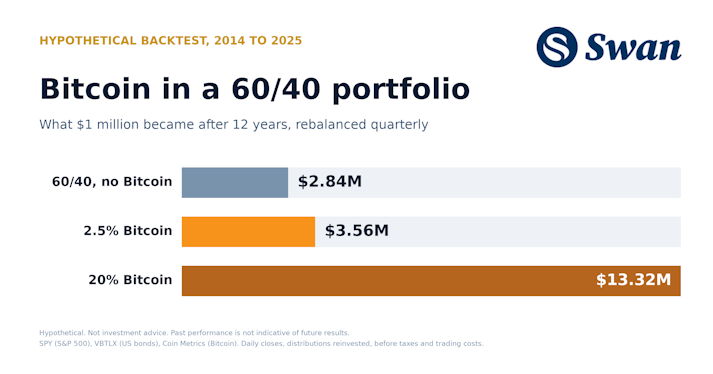
How much Bitcoin to hold in a 60/40 portfolio: 2.5% lifted annual returns from 9.1% to 11.2% (2014–2025). Results from 1% to 20%, drawdowns and method.
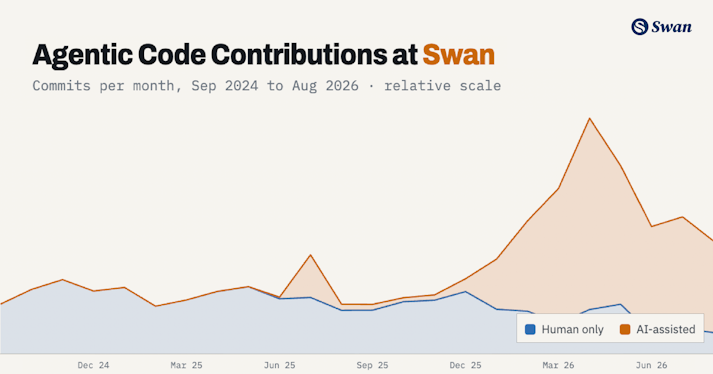
How Swan built an agentic software factory that finds production bugs, reaches consensus on the fix, opens the PR, and proves it works before a human merges.