


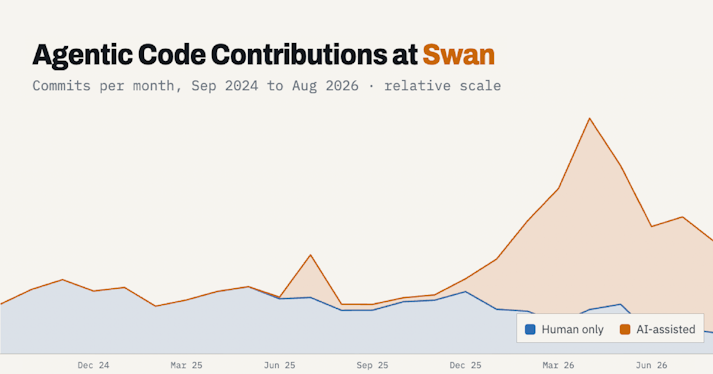

Swan’s Agentic Software Factory: Cygnet Evolved


How Swan built an agentic software factory that finds production bugs, reaches consensus on the fix, opens the PR, and proves it works before a human merges.
In this article
A spot Bitcoin ETF tracks the price of Bitcoin. Owning shares is not the same as owning Bitcoin.
That difference sounds academic until you sit with what it means. Buying a share of IBIT or FBTC makes you a shareholder in a fund. The fund owns Bitcoin through a custodian, and the whole stack is governed by rules you did not write. Buying real Bitcoin and holding the keys makes you the owner of a bearer asset that settles on the most secure monetary network currently operating.
For most long-term holders, that is not a close call. Here is why.
IN THIS ARTICLE
What a Bitcoin ETF actually is
Why ownership is the whole point
Access and hours
Fees compound over decades
What Swan is built to do
When an ETF still makes sense
The bottom line
A spot Bitcoin ETF is a security that holds Bitcoin on behalf of shareholders. When you buy a share of IBIT, FBTC, ARKB, or any other spot product, a regulated fund sponsor issues you a claim against Bitcoin held by a qualified custodian (almost always Coinbase Custody). You do not hold Bitcoin. You hold a legal interest in a fund that holds Bitcoin on your behalf.
That structure has real benefits. ETF shares trade in brokerage accounts. They fit inside 401(k) wrappers for plans that allow it. They settle in dollars and they are tax-reported like any other security. For an investor who wants price exposure inside the portfolio they already have, an ETF is a reasonable tool.
An ETF share is still a claim, not an asset. The claim sits on top of several layers of intermediaries: the fund sponsor, the authorized participants, the custodian, and the brokerage that holds the share in street name on your behalf. Every one of those intermediaries is a point of failure that Bitcoin was designed to remove.
Bitcoin exists because the trust-based model has inherent weaknesses. That is not a slogan. It is the opening argument of the white paper Satoshi Nakamoto published in 2008, which called out commerce’s reliance on financial institutions as trusted third parties as the core problem Bitcoin was built to solve. A decade earlier, Nick Szabo had put it more bluntly: trusted third parties are security holes.
Every part of the protocol is built to eliminate the need to trust custodians, clearinghouses, and issuers. A Bitcoin you control with your own keys cannot be frozen, reversed, confiscated, diluted, or lent out behind your back. It settles on the base layer of the network every ten minutes, whether or not any particular company is still in business.
A Bitcoin ETF share gives up most of that. If the custodian fails, the fund sponsor is in a bankruptcy proceeding rather than your wallet. If the brokerage gets hacked, the SIPC insurance that covers securities does not cover the Bitcoin itself. If regulators change the rules on how the fund operates, you are along for the ride. None of that is a prediction. It is the nature of securities held in street name through a layered intermediary stack.
The question is not whether you trust BlackRock today. The question is whether you want to need to trust anyone ten or twenty years from now, during a crisis you cannot currently imagine.
Bitcoin settles every ten minutes, including weekends and holidays. ETF shares do not. When US markets close at 4 PM Eastern on Friday, your ability to buy or sell a Bitcoin ETF ends until Monday morning. The underlying asset keeps trading the whole weekend. Major moves in the Bitcoin market, the kind that tend to happen during geopolitical shocks or weekend news, regularly occur when the ETF wrapper is closed.
Owning real Bitcoin means the asset is yours at 2 AM on a Saturday the same as at noon on a Tuesday. It means you can send it across a border without asking permission. The ETF wrapper reintroduces the business hours and geographic limits that Bitcoin was built to escape.
Spot Bitcoin ETFs charge an ongoing expense ratio. Most cluster between 0.20% and 0.25% per year after introductory waivers expire. That is small on a one-year horizon and significant on a twenty-year horizon.
On a $100,000 position held for twenty years at a 0.25% expense ratio, you pay roughly $5,000 to $15,000 in fees depending on how Bitcoin’s price performs over the period. Real Bitcoin held in self-custody has no expense ratio. Once it is yours, there is no annual tax levied by an issuer for the privilege of holding it. For long-term holders, that difference compounds directly into how much Bitcoin you end up with.
Swan is a Bitcoin-only company. We do not sell crypto or memecoins. We do not sell paper Bitcoin. Every product we ship is built for the same outcome: you end up actually owning your Bitcoin, on your own keys.
Here is what that looks like in practice.
You can buy Bitcoin on Swan and have it automatically withdrawn to your own wallet on every purchase. No sitting on an exchange waiting for you to remember. No default to custodial storage. Real Bitcoin, moved to your addresses, on the schedule you choose. The default is ownership, not custody by us.
Swan Vault handles the next problem: where the Bitcoin lives once it is yours. Vault is a collaborative custody setup that keeps you in control of your keys while removing the risk of losing everything to a single lost seed phrase or a compromised device. Two of three keys are held by you and your chosen recovery partner. One key is held by Swan. No single party can move the Bitcoin on its own. If Swan disappears tomorrow, you can still recover your Bitcoin. If you lose one of your keys, so can you.
Swan IRA and Swan Business extend the same principle to the places long-term capital actually lives: retirement accounts and corporate treasuries. The Bitcoin inside both products is held by a qualified custodian on your behalf rather than wrapped inside an ETF, and it can be transferred out to self-custody when the account rules allow it. That is not an option inside IBIT or FBTC. Every Swan Private client also gets a Bitcoin Plan advisor. Not a salesperson. Someone whose job is to help you think through custody, taxes, inheritance, and how you build a long-term Bitcoin position over decades.
To be fair, there are situations where an ETF is the right choice. If your only meaningful pool of capital is inside a 401(k) that does not permit outside investments, an ETF is the only way to get Bitcoin exposure in that wrapper. If you need a tax-reported security for a trust, estate, or corporate account governed by rules that prohibit direct commodity holdings, the ETF solves a legal problem. If you are allocating inside a managed portfolio where the advisor only has access to listed securities, the ETF is the path of least resistance.
For almost every other investor, ETF exposure should be a starting point. The logical end state is owning real Bitcoin, on your own keys, in an account structure you control.
A Bitcoin ETF share is a financial product built to fit Bitcoin inside the existing system. Real Bitcoin is a financial asset built to replace parts of that system over time. Those two goods serve different goals and carry different trade-offs. Don’t confuse them.
Investors who come looking for “real Bitcoin, not an ETF” already know what they want. They want the asset itself. Swan is built to help them get it and to help them keep it for as long as they want to hold.
If that is the decision you are making, open a Swan account and start building a real Bitcoin position.
Brady is a Swan cofounder focused on Product Marketing and Education. He launched Citizen Bitcoin and Swan Signal Live, two popular Bitcoin podcasts.
Thoughts on Bitcoin from the Swan team and friends.
How Swan built an agentic software factory that finds production bugs, reaches consensus on the fix, opens the PR, and proves it works before a human merges.
Total federal debt crossed $40 trillion last week. Jeremy Showalter maps how we got here, where four institutional projections take it by 2050, and why the honest total is already about $55 trillion.
From entropy and SHA-256 to proof of work and the 21 million cap: a first principles guide to how Bitcoin works, and what you can verify yourself.