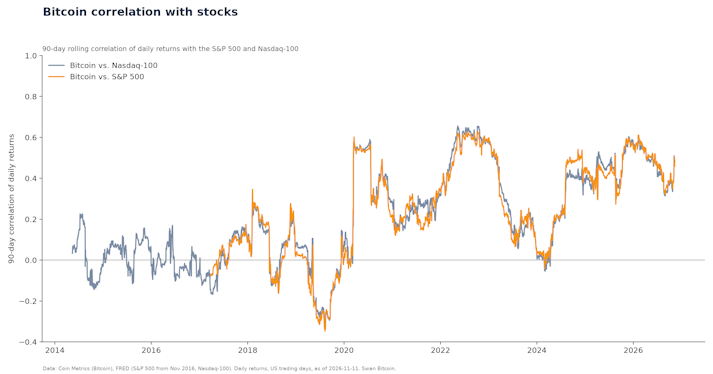

Bitcoin Correlation With Stocks: S&P 500 & Nasdaq Data


Bitcoin’s correlation with the S&P 500 was 0.42 in 2025 and 0.46 over the last 90 days (Nov 2026). Yearly data since 2017, Nasdaq, dollar and crash days.
In this article
IBIT charges 0.25% a year and GBTC charges 1.5%, six times as much. Both are spot Bitcoin ETFs that hold real Bitcoin with Coinbase Custody, so over the long run the fee is the main difference in what you keep. BlackRock’s iShares Bitcoin Trust ETF (IBIT) is also by far the larger fund: about 793,000 BTC on November 10, 2026, against about 127,000 BTC for the Grayscale Bitcoin Trust ETF (GBTC) on September 30, 2026.
This comparison covers each fund’s fee, holdings, structure and history, what the fee gap costs in dollars and in Bitcoin, and how both compare with holding Bitcoin yourself. Swan doesn’t recommend either fund, and nothing here is investment advice.
Sponsor fee: IBIT 0.25%; GBTC 1.5%
Bitcoin held: IBIT about 793,000 BTC (November 10, 2026); GBTC 126,988 BTC (September 30, 2026)
Net assets: IBIT $58.3 billion (November 10, 2026); GBTC $10.6 billion (September 30, 2026)
Exchange: IBIT on Nasdaq; GBTC on NYSE Arca
Custodian: Coinbase Custody for both; GBTC also names Anchorage Digital as an alternative custodian
Launched as an ETF: IBIT January 5, 2024; GBTC January 11, 2024 (a private trust since 2013)
Yearly fee on $10,000: IBIT $25; GBTC $150
Sources: iShares and Grayscale’s 10-Q for September 30, 2026. IBIT’s Bitcoin count is Swan’s calculation from iShares' published basket: 22.64 BTC per 40,000 shares, times 1,401,280,000 shares outstanding.
IBIT’s sponsor fee is 0.25% a year, or $25 on a $10,000 position. At launch in January 2024, BlackRock waived part of the fee, down to 0.12% for the first 12 months or first $5 billion. That waiver has ended, and iShares lists the full 0.25% today.
iShares
IBIT held about 793,000 BTC on November 10, 2026, worth $58.3 billion in net assets. That makes it the largest spot Bitcoin ETF in the U.S.; our Bitcoin ETF fee guide shows it holding about 63% of all the Bitcoin in U.S. spot ETFs in October 2026. Its 30-day median bid/ask spread was 0.02%, so trading it costs very little.
GBTC charges 1.5% a year, the highest of any U.S. spot Bitcoin ETF. Grayscale’s latest quarterly report still describes the fee as “an annual rate of 1.5% of the aggregate value of the Trust’s assets,” paid in Bitcoin every day.
GBTC started in 2013 as a private trust and traded over the counter from 2015. When it converted to an ETF on January 11, 2024, IBIT launched at 0.25% with a temporary waiver, but Grayscale kept its 1.5% fee. Before the conversion, GBTC shares often traded at large premiums or discounts to the Bitcoin they represented, because the trust had no ongoing way to create and redeem shares. Since the conversion it has one, which keeps the share price close to the value of its Bitcoin.
GBTC held 126,988 BTC on September 30, 2026, according to its 10-Q, worth $10.6 billion. It has been shrinking ever since it became an ETF, as holders sold out of the high-fee fund:
January 2024 (ETF conversion): about 619,000 BTC
June 28, 2024: 275,758 BTC (Grayscale)
December 31, 2025: 165,591 BTC (10-Q)
September 30, 2026: 126,988 BTC (10-Q)
That is a drop of about 79% since the conversion. In the first nine months of 2026 alone, 52.8 million GBTC shares were redeemed and 5.2 million created.
Grayscale.com
Each fee is charged on your balance every year. Assuming a flat Bitcoin price, so only the fee changes the result:
$10,000 for 10 years: about $247 in IBIT fees and about $1,403 in GBTC fees, a difference of about $1,156.
1 BTC for 10 years: IBIT takes about 0.025 BTC (2.5 million sats); GBTC takes about 0.14 BTC (14 million sats).
Original calculation: GBTC collects almost as much Bitcoin in fees as IBIT. At current holdings, IBIT’s 0.25% takes about 1,983 BTC a year from its holders, and GBTC’s 1.5% takes about 1,905 BTC. GBTC holds about one-sixth as much Bitcoin as IBIT but collects about 96% as much in fees.
That depends on your situation, and Swan can’t give you individual advice. The trade-off is simple to state, though. Selling GBTC in a taxable account can trigger capital gains tax, while staying costs 1.25 percentage points more a year than IBIT. In an IRA or other tax-advantaged account, switching funds has no immediate tax cost. A tax professional can tell you which applies to you.
Grayscale’s own lower-cost option is the Grayscale Bitcoin Mini Trust ETF (ticker BTC), which charges 0.15%. Morgan Stanley’s MSBT, launched in April 2026, is the cheapest U.S. spot Bitcoin ETF at 0.14%. The ETF fee guide above lists all 13 funds. You can also compare GBTC with Fidelity’s FBTC, the futures-based BITO and MicroStrategy (MSTR) stock.
Both hold real Bitcoin. Neither uses futures. Each share represents a slice of the Bitcoin the fund holds.
Both use Coinbase Custody. Your Bitcoin sits with the fund’s custodian, not with you.
Neither lets you withdraw Bitcoin. You own shares, not coins. You can’t send them to your own wallet or use them on the Bitcoin network.
Both trade during market hours. Bitcoin trades around the clock, but ETF shares only trade when U.S. stock exchanges are open.
Both fit in brokerage and retirement accounts. That is the main reason to choose an ETF over Bitcoin itself.
An ETF gives you Bitcoin’s price inside a brokerage account, but you pay a fee every year and never hold the Bitcoin. Bitcoin you buy and withdraw to your own wallet has no yearly fee. At Swan, buys cost 1% and withdrawals are $0 (see fees). At IBIT’s 0.25%, the yearly fees pass that one-time 1% after about four years. At GBTC’s 1.5%, they pass it in about eight months.
For why ownership matters beyond cost, read Buy Real Bitcoin, Not a Bitcoin ETF and What Bitcoin ETFs Mean for You. If you hold Bitcoin yourself, our guide to Bitcoin cold storage covers keeping it safe. For retirement accounts, compare the best Bitcoin IRAs, which hold real Bitcoin rather than ETF shares.
Hold your IRA with the most trusted name in Bitcoin.
For cost, IBIT: it charges 0.25% a year against GBTC’s 1.5%, and it is larger and more heavily traded. Both hold real Bitcoin with Coinbase Custody. Which one suits you depends on your account type and taxes, so this isn’t advice.
0.25% a year. The launch waiver that cut it to 0.12% has ended.
1.5% a year, the highest of any U.S. spot Bitcoin ETF.
Yes. GBTC converted from a trust that traded over the counter into an ETF on January 11, 2024, and now trades on NYSE Arca.
About 793,000 BTC on November 10, 2026, based on iShares' published basket and shares outstanding.
126,988 BTC on September 30, 2026, down from about 619,000 BTC when it converted to an ETF in January 2024.
No. You own fund shares, not Bitcoin, and you can only sell them for dollars.
iShares, iShares Bitcoin Trust ETF (IBIT): sponsor fee, net assets, shares outstanding, basket Bitcoin amount and bid/ask spread, as of November 10, 2026
Grayscale Bitcoin Trust ETF, Form 10-Q for the quarter ended September 30, 2026 (SEC, filed November 5, 2026): Bitcoin held, net assets, fee, custodians, listing history, share redemptions
Grayscale, GBTC key fund information, June 28, 2024 (screenshot above)
Swan, Bitcoin ETF Fees: Lowest to Highest (linked above): Mini Trust and MSBT fees, IBIT’s share of U.S. ETF Bitcoin, GBTC’s holdings at conversion
Swan’s calculations: IBIT holdings from basket and shares outstanding; yearly fees in BTC are holdings times fee; 10-year costs assume a flat Bitcoin price, with the fee charged on the remaining balance each year
Drew, a class of 2013 Bitcoiner, is a Research Analyst for Swan Bitcoin.
He has worked in institutional VC/PE, FinTech, and DLT consulting for over six years. He also brings over twelve years of experience working with national nonprofits and start-ups in education and software development in several leadership roles.
In this article
Thoughts on Bitcoin from the Swan team and friends.
Bitcoin’s correlation with the S&P 500 was 0.42 in 2025 and 0.46 over the last 90 days (Nov 2026). Yearly data since 2017, Nasdaq, dollar and crash days.
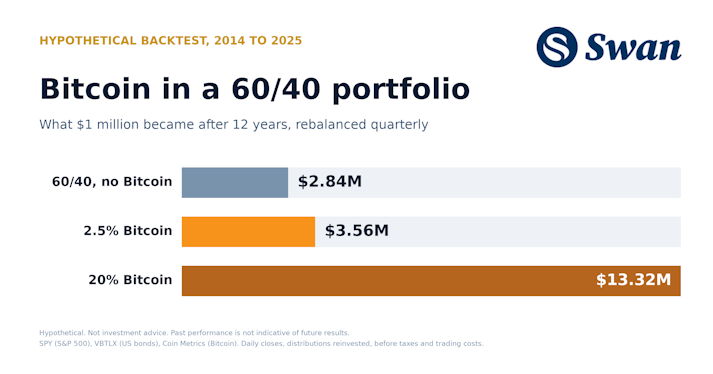
How much Bitcoin to hold in a 60/40 portfolio: 2.5% lifted annual returns from 9.1% to 11.2% (2014–2025). Results from 1% to 20%, drawdowns and method.
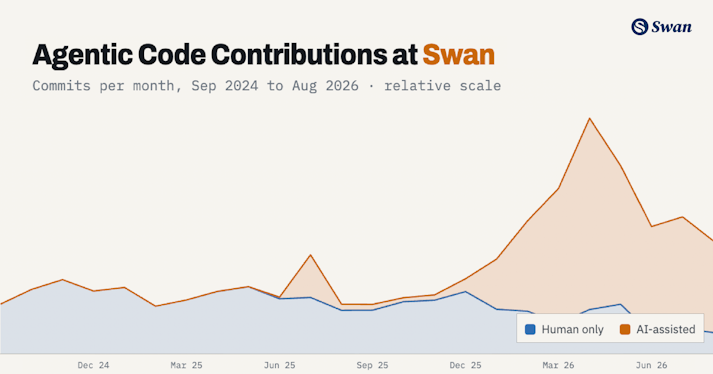
How Swan built an agentic software factory that finds production bugs, reaches consensus on the fix, opens the PR, and proves it works before a human merges.