









A Brief History of Bitcoin Forks


A history of every Bitcoin hard fork, from Bitcoin Cash and Bitcoin Gold to the 2026 BIP-110 split, and why each new coin collapsed against Bitcoin.
In this article
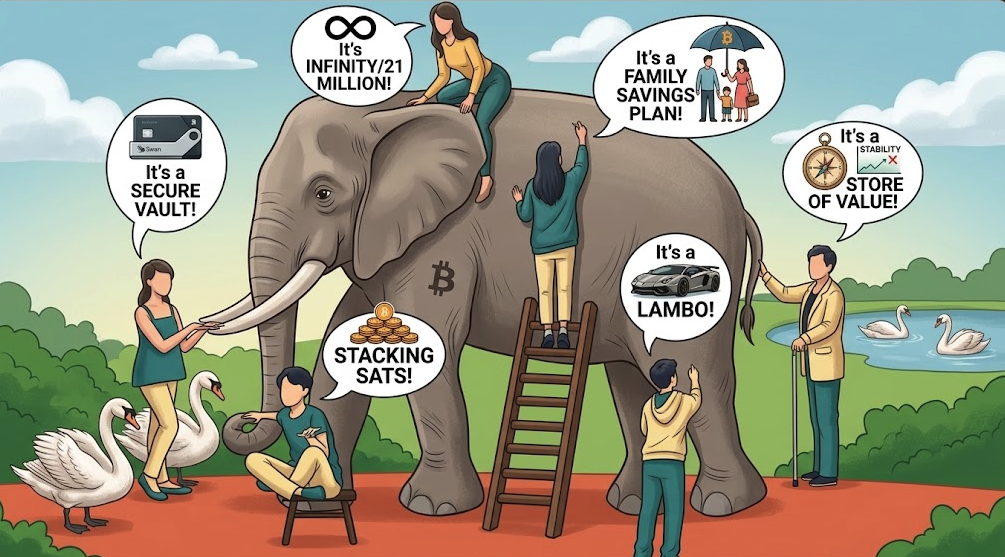
Ask ten people how Bitcoin works and you get ten slogans. Digital gold. Money without banks. An immutable ledger. Each one holds some truth, and none of them shows you the whole picture.
Bitcoin asks something unusual of you. It offers money you can hold without anyone’s permission, and in exchange it hands you responsibility for understanding what you are actually trusting.
In January 2009, days after the network launched, the cryptographer Hal Finney posted two words on twitter: “Running bitcoin.” A second computer had started receiving the same data as the first and checking it against the same rules. Seventeen years later, that is still the whole idea.
Here is the tour in five pieces: who controls the ledger, what protects your coins, where that protection comes from, how coins move, and why 21 million holds. No price talk, and no pretending the trade-offs do not exist.
Every form of money has a ledger, meaning a record of who owns what and a process that decides when the record changes. The interesting question is never whether a ledger exists, but who gets to write in it.
Lyn Alden frames this beautifully in Broken Money. With gold, nature controls the ledger, and supply grows only as fast as people can dig. With dollars, euros, and every other national currency, central banks and the commercial banking system control it. When your banking app shows $4,000, that is a row in a database, and the institution can edit the row.
Bitcoin does something genuinely new. Its ledger is a shared copy held by tens of thousands of independent computers around the world, each one checking every rule for itself. No company hosts it. No board approves changes to it.
Three jobs make that work, and they get blurred together constantly, so it is worth separating them now
A wallet is software, hardware, or both, and it stores your secrets and builds transactions. A miner is a computer that bundles pending transactions into a block and competes for the right to add it. A node is a computer running the full rulebook, checking every block and every transaction, and rejecting anything that breaks a rule.
Miners propose. Nodes decide. A miner can spend a fortune in electricity producing a block, and if that block contains one invalid transaction, every node on the network throws it away. Mining power buys a place in line for the block subsidy and the transaction fees. It never buys permission to break the rules.
A node runs on hardware cheaper than a phone, and anyone can run one. That open door is the point, whether or not you personally walk through it.
Now to the part that touches you directly.
Bitcoin has no accounts and no passwords. What it has are secrets. Every coin on the ledger is locked to a secret number called a private key, and the rule is blunt: whoever knows the secret can move the coins. There is no fraud department, no chargeback, and no password reset. That is what makes Bitcoin portable and permissionless, and it is also the single biggest responsibility it hands you.
So the security of your bitcoin comes down to one question. How hard would it be for someone else to discover your secret?
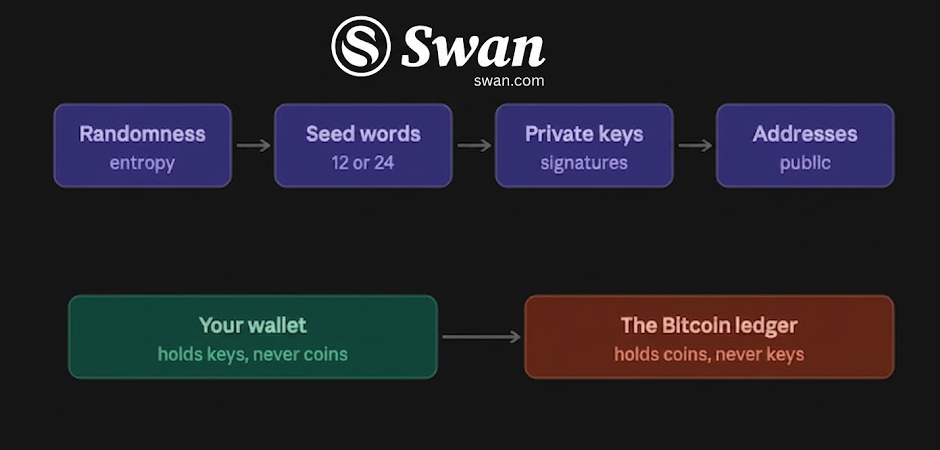
Most people never handle a raw private key. Modern wallets hide it behind a list of recovery words, usually twelve or twenty-four of them. Those words are the master secret. From them, your wallet mathematically derives a whole family of private keys, and from those keys it derives public addresses you can safely share.
Only the first step in that chain involves chance. Everything after it is pure arithmetic, which is why twelve words on paper can restore a wallet containing thousands of addresses. It also means anyone who obtains those words can rebuild your wallet, and losing the only copy can cost you the ability to rebuild it yourself.
One more correction to the folk model, because it clears up a lot of confusion. Your coins are not inside your wallet, and they are not inside an address. Coins live on the shared ledger. Your wallet holds the keys that unlock them.
If security depends on nobody guessing your secret, then a lot depends on how that secret was created. Cryptographers measure this with a word worth learning: entropy, which simply means unpredictability.
Picture a fair coin. Before it lands, two outcomes are equally likely and you cannot do better than guessing. Now picture a weighted coin that lands heads ninety-nine times out of a hundred. Still two outcomes, almost no unpredictability. Guess heads every time and you will be right nearly always.
A private key works the same way. The key is a container built to hold 256 bits. Entropy is what fills it. If the process that generated your key could only ever draw from a small set of possibilities, an attacker never has to search the astronomical space of all possible keys. The attacker only has to replay the broken machine that built yours.
This is not a thought experiment. In 2013, a flaw in Android’s random number generation caused values that should never repeat to repeat, and the repetition exposed the keys behind the affected signatures. Funds were swept. The bitcoin.org advisory from August 2013 is still online, and Google’s own postmortem confirmed the underlying generator was improperly initialized.
The same failure returned in July 2026. A firmware change in COLDCARD devices routed seed generation away from the device’s hardware random number generator and into a software fallback, which is a far more predictable source than the hardware it replaced. The affected seeds carried substantially less entropy than the 128 bits they were supposed to hold. The devices themselves were never remotely accessible. The problem was that the keys they generated were weak enough that an attacker with sufficient computing power could feasibly search the reduced keyspace and recover them.
The most important detail is that the risk follows the seed. If you generated your recovery words on affected firmware, that seed may be weaker than intended even if you have since moved it to a different wallet, and updating the firmware corrects future seed generation without repairing a seed that already exists. Version numbers are the thing to check, and the version that matters is the one running the day the seed was created.
If you think you might be affected, read the official COLDCARD security advisory first, and get there by typing the address yourself rather than following a link from an email or a sponsored search result. The advisory carries a narrow exception for seeds built from at least fifty independent private dice rolls, and notes that a strong, unique BIP-39 passphrase creates a separate barrier an attacker would also have to defeat. Everything outside those cases points toward generating a fresh seed on fixed firmware and moving the funds.
Move deliberately. Within days of the disclosure, attackers were sending spoofed emails inviting holders to complete a “hardware audit,” linking to a cloned site staffed by a live chat operator who walked victims through installing remote-access software. Fake support accounts and seed-checking tools followed, all designed to collect the one thing the original flaw never needed. No legitimate party will ever ask for your recovery words. There is no audit tool, no verification portal, and no support agent who needs to see your seed. Coinkite’s own advisory makes the same point: mistakes made during recovery can cause more damage than the vulnerability itself. Urgency is the attacker’s best tool right now, so refuse to supply it. If you are unsure how to proceed, reach out to our team at swan.com/support and we are happy to walk through a safe migration with you.
For everyone else, the lesson generalizes cleanly, and it is the most useful principle in Bitcoin security:
A secret is only as strong as the process that created it.
Done properly, the math is overwhelming in your favor. A truly random 256-bit secret sits somewhere in a space around 78 digits wide, and no machine that could physically exist will search it. That is why good wallets draw randomness from dedicated hardware, and why some people add their own dice rolls on top. Entropy is far from the only thing that can go wrong in self-custody, but it is the one thing that cannot be fixed afterward. Meaning if your wallet does not have sufficient entropy you need to move funds asap to one that does.
Spending bitcoin works a little like spending cash. Hand a cashier a hundred-dollar bill for a thirty-dollar item and the bill does not get shaved down to seventy dollars. The hundred-dollar bill is spent, and you receive change.
Bitcoin works similarly. Your wallet controls discrete chunks of bitcoin called unspent transaction outputs, or UTXOs. Each UTXO was created by an earlier transaction and can be spent only once. If your wallet controls a UTXO worth 0.001 BTC and you want to send someone 0.0003 BTC, that UTXO may be spent in full. The transaction could create one output paying 0.0003 BTC to the recipient and another returning most of the remaining bitcoin to you as change. The small difference between the total value of the inputs and outputs becomes the transaction fee.
Your wallet usually handles this automatically, but you can have more control than the cash analogy suggests. You choose how much bitcoin you want to send, and some wallets offer coin control, which lets you choose exactly which UTXOs will be used as inputs. This can matter for privacy, fees, and how you organize your bitcoin.
You can also choose the transaction’s fee rate. Bitcoin fees are determined primarily by how much block space your transaction consumes, measured in virtual bytes, and how many satoshis you are willing to pay per virtual byte. A transaction using several UTXOs is generally larger than one spending a single UTXO, so it can cost more even if both transactions send the same amount of bitcoin.
When a wallet offers options such as low, normal, or high priority, it is estimating a fee rate based on current demand for block space. In a typical transaction with change, a higher fee means slightly less bitcoin comes back to you as change. Miners generally favor transactions offering higher fee rates. Thus, if you pay a competitive rate your transaction is more likely to confirm quickly. Pay less and it may remain unconfirmed until demand falls. An unconfirmed transaction can also eventually disappear from mempools, or in some cases be replaced with a higher-fee version, so it is better to think of the mempool as a market for scarce block space rather than a permanent line.
Your displayed balance is simply your wallet adding up every UTXO your keys can spend. Bitcoin does not keep an account in your name. It keeps a record of coins, and possession of the right keys determines who can spend them.
The first transaction in every block is special. It creates new bitcoin, and it lets the miner claim the reward permitted at that point in the schedule plus the fees from that block.
The miner does not choose the number. Every node independently calculates the maximum allowed and rejects the entire block if the miner claims even one satoshi more. The reward started at 50 BTC in 2009 and halves every 210,000 blocks, roughly every four years. It fell to 3.125 BTC in April 2024. Around the year 2140 it rounds down to zero, and the schedule sums to just under 21 million.
So the supply cap is an arithmetic check performed continuously by machines that answer only to their owners.
Could it change? Anyone can edit the software this afternoon. What nobody can do is force other people to run it. A version with different supply rules produces a different asset, and existing nodes reject the extra coins. This has been tested. In 2017 a faction split off to raise the block size, and the chain enforcing the original rules kept the name, the liquidity, and the economic weight.
Call the cap what it honestly is. Not a law of physics, and not a promise either. It is a published rule that millions of people can verify at almost no cost, which is a stronger guarantee than money has ever had before, and it lasts exactly as long as people keep checking.
Nobody audits every chip, compiler, and line of code they depend on. You might generate your own keys and use somebody else’s node. You might run your own node and trust the silicon underneath it. You might use a hardware signer and trust that the firmware does what its documentation says, which is exactly the assumption that broke in 2026. That failure was cruel in a particular way. The people it caught had followed the advice. They bought reputable hardware, generated their keys offline, kept the words off any screen, and the device failed them at the one step they had no practical way to inspect.
What kept it from being worse is the same property that made it visible at all. The firmware source was published, which let outside researchers inspect the implementation and reproduce release builds rather than take a product description on faith. Open code did not prevent the failure. It made the failure legible.
So verification is less a wall than an accounting. You never reach zero trust. What you decide is where yours sits, how much of it rests in any single place, and how quickly you would learn if it had been misplaced.
Every custody choice moves that trust somewhere. Leave bitcoin with a custodian and you are trusting an institution to safeguard keys and honor your claim. Move it to your own wallet and the whole responsibility transfers to you, including backups, firmware, physical security, and the discipline to keep all three current for as long as you hold. Multisignature spreads the exposure so that no single key and no single device can lose everything, at the price of a setup you need to understand well enough to recover from under stress. Collaborative custody divides the work between you and a provider, which can help remove single points of failure.
The useful question is which specific failure you could survive, and whether you would notice it in time. There is no arrangement with zero trade-offs. There are only trade-offs you understand and trade-offs you have not looked at yet.
Here is what makes Bitcoin remarkable once the pieces come together. Randomness makes keys unguessable. Signatures prove authorization without revealing anything. Mining makes writing history expensive and rewriting it far more expensive. Verification is nearly free, so a machine in your closet can audit the entire money supply of a global network. Nobody had that before, at any price.
You do not need to run a node to own bitcoin, and you do not need to understand elliptic curves to buy your first satoshi. Understanding the machine changes something else. It changes how you hold through a drawdown, and how deliberately you choose who holds your keys.
That is why Swan is Bitcoin-only, and why education comes before product selection here. Automatic recurring buys let you accumulate steadily without watching charts. The Swan IRA covers tax-advantaged holding. Swan Vault supports collaborative self-custody with a real human on the other end to answer your questions. If you want the longer technical version of everything above, our co-founder Yan Pritzker’s book Inventing Bitcoin is free.
See the whole picture. Understand where you moved your trust. Then choose the setup that fits the risks you actually face.
Where is my bitcoin actually stored? On the shared ledger, as transaction outputs. Coins never sit inside a wallet, an address, or a hardware device. Your wallet stores the private keys that can unlock those outputs, which is why losing a device is survivable when your backup is intact.
What is the difference between a seed phrase and a private key? A seed phrase is recovery information from which a wallet derives many private keys. A private key is one individual secret used to authorize one spend. Twelve or twenty-four words can correspond to thousands of keys and addresses.
What is the difference between a miner and a node? Miners assemble candidate blocks and spend energy competing to add the next one. Nodes check every block against the rules and reject violations regardless of how much work is attached. Miners propose, nodes verify.
Why is Bitcoin limited to 21 million? The block reward halves every 210,000 blocks and eventually rounds down to zero around 2140. Every node calculates the maximum reward allowed and rejects blocks that create more, so the cap is enforced continuously by the whole network rather than promised by anyone.
Do I need to run a node to use Bitcoin? No. Without one you rely on someone else’s infrastructure for your view of the blockchain, which can be a reasonable choice depending on the situation. Running a node lets you verify Bitcoin’s rules independently. Whether that is worth the effort depends on your holdings and your comfort with the setup.
This article is for educational purposes only. It is not investment, tax, legal, or security advice, and it is not a recommendation to buy, sell, or hold any asset. Third-party products and disclosures referenced here are described as reported by their publishers as of August 2026, and Swan is not affiliated with those companies and does not endorse or evaluate their products. Details of ongoing security investigations may change. Always consult the manufacturer’s official guidance and a qualified professional before making decisions about your own holdings.
Thoughts on Bitcoin from the Swan team and friends.
A history of every Bitcoin hard fork, from Bitcoin Cash and Bitcoin Gold to the 2026 BIP-110 split, and why each new coin collapsed against Bitcoin.
After the Coldcard exploit, everyone is asking the same question: is my Bitcoin custody setup safe? Swan’s CTO opens up the hardware behind Swan Vault and answers it.
Managing a substantial Bitcoin position across custody, trusts, retirement accounts, inheritance, and decades of family change is hard. Here is what a serious Bitcoin concierge relationship should solve.