





What is a Bitcoin Fork?


Unlike a stock split, the new shares still refer to the original company; a Bitcoin fork creates new assets out of thin air at zero cost and grifts them to existing holders. A fork does not affect the 21M supply limit.
In this article
There’s a new faction in town about to create a Bitcoin hard fork, also known as an altcoin, led by Luke Dashjr, a long-time Bitcoin developer, following the failure of a soft fork known as BIP 110 to gain consensus. But this is not a new pattern. Bitcoin has seen a number of forks in its history, each time led by someone who wasn’t happy with the way things were going, or wanted to get rich by dumping their new forkcoin on unsuspecting buyers, or both. What followed in every case was severe economic destruction of their newly created coin relative to Bitcoin. Today I aim to illuminate some of that history for people who weren’t around to see it firsthand.
The first big explosion of Bitcoin forkcoins came as a result of or in the wake of the Blocksize Wars. Bitcoin’s transaction capacity was capped by a 1 MB block size limit, which affected how many transactions could be stuffed into a Bitcoin block, which occurs once every ten minutes on average. As blocks filled and fees rose, the community split into two irreconcilable camps: the “big blockers,” who wanted to raise the limit and scale on-chain, and the “small blockers,” who argued that bigger blocks would centralize the network by making it too expensive for ordinary people to run a node. A non-obvious key issue in the debate was that increasing the block size in the way that the big blockers wanted would have led to a hard fork, meaning that all Bitcoin nodes would have to do a mandatory upgrade or be kicked off the network.
The big blockers included a large portion of miners as well as Bitcoin businesses such as exchanges and payment processors. In fact, they appeared to represent a huge majority of the industry: the May 2017 New York Agreement was signed by 58 companies in 22 countries representing 83% of hash power and 20.5 million wallets. The small blockers consisted mostly of technical developers and users, both groups that vehemently opposed the centralization of bigger blocks and, more than that, the need for a hard fork, which would potentially disrupt the key value proposition of Bitcoin, its immutability.
In my view, the way to do the block size increase (a forced hard fork, or an optional soft fork), and not actually the block size itself, was a key crux of the debate. The reason I hold this to be true is that the “small block” developers were proposing a change called Segwit, which effectively doubled the block capacity anyway, and paved the way for scaling using the Lightning network, without a hard fork. Instead, their change was implemented as a soft fork, which means that any nodes that chose not to upgrade would continue functioning as normal, processing the new information as if it didn’t exist. It seems difficult to believe that the main debate was whether the block size should be doubled or quadrupled, or 8x’ed, as no amount of on-chain scaling would have permanently solved the Bitcoin scaling issue anyway, considering that it was to be adopted as global money by 8 billion or more people.
The non-technical public reduced the debate to small and big blocks, but really it was a governance debate: should a group of companies, even representing the vast majority of miners and custodial users, be able to change the Bitcoin protocol in a hard fork, non-backward compatible way? The big blockers believed that they had to implement this change “for the good of the network” so that Bitcoin could scale. Alternatively, on a more cynical reading, they wanted to increase the throughput of the network so that it could process more transactions and they could earn more fees for their business. The small blockers believed, by and large, that changes had to be implemented in a conservative fashion that is backward compatible with a soft fork, that hard forks were an unpalatable approach, and that on-chain scaling would lead to node centralization.
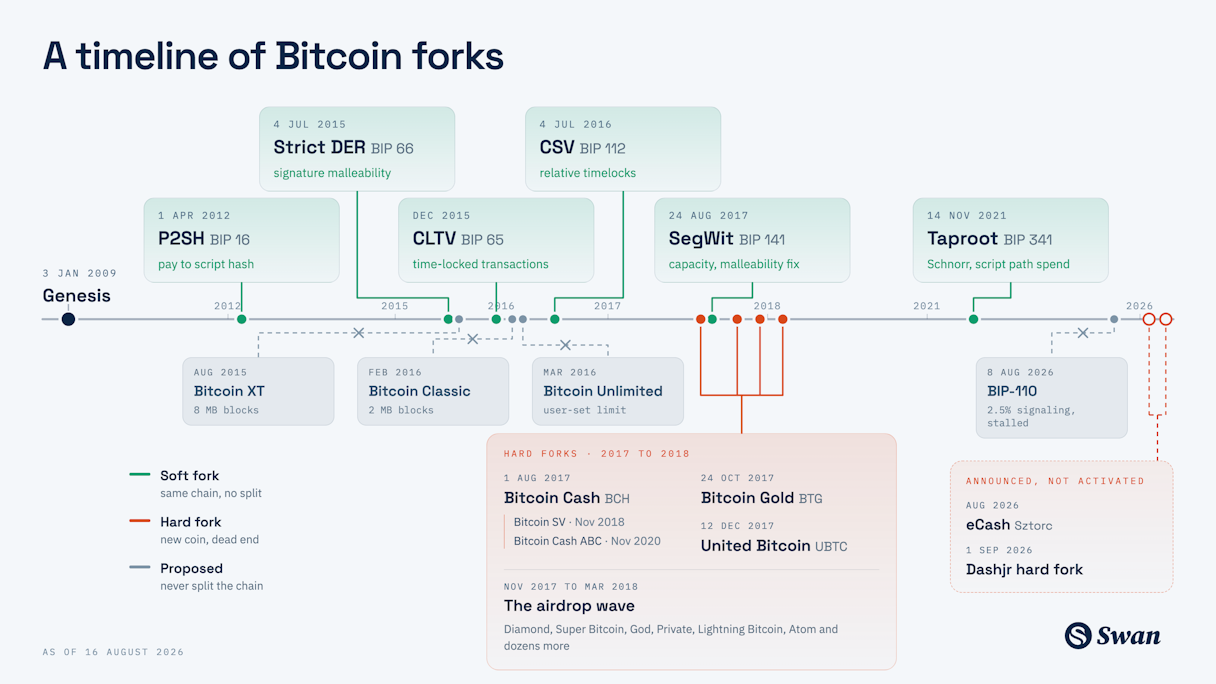
The first real breakaway client was Bitcoin XT in 2015, championed by early Bitcoin developers Mike Hearn and Gavin Andresen, which proposed raising the block size by 8x to 8mb. It never captured any serious network share, and its failure produced Bitcoin’s first great rage-quit: on January 14, 2016, Hearn published a widely-read Medium post, “The resolution of the Bitcoin experiment,” declaring Bitcoin a failure, writing that he had “sold all my coins,” and was leaving entirely. Bitcoin was around $400 at the time. Today it trades more than 150x that value. Hearn, thankfully, did not launch an altcoin; he went to work on corporate blockchains instead.
Bitcoin Classic and Bitcoin Unlimited followed in 2016 as successive big-blocker clients, each trying and failing to muster enough miner and node support to change the rules. None of them split the chain into a rival coin. But they hardened the trenches, and they introduced the pattern that would become a staple in the forks that followed: a figurehead, a technical grievance, and the conviction that Bitcoin needed to be saved.
The wars finally threatened to crack the chain in half on August 1, 2017. The big blockers gave up on changing Bitcoin and forked their own network into existence: Bitcoin Cash (BCH), launching with 8 MB blocks and a promise to be “peer-to-peer electronic cash” for the world. The two chains were identical up to block 478,558, so anyone who owned one bitcoin at the fork automatically owned one BCH: free money, on paper.
It had the closest thing the fork world would ever get to a dream team of patrons. Roger Ver, an early Bitcoin investor evangelical enough to have earned the nickname “Bitcoin Jesus”, became its loudest promoter, using his control of the domain bitcoin.com to present Bitcoin Cash as the true Bitcoin to a generation of newcomers who didn’t know the difference. Bitmain, the mining-hardware giant co-founded by Jihan Wu, backed it with hash power. Amaury Séchet led the Bitcoin ABC team that wrote the software. They even got it listed on major exchanges all over the world.
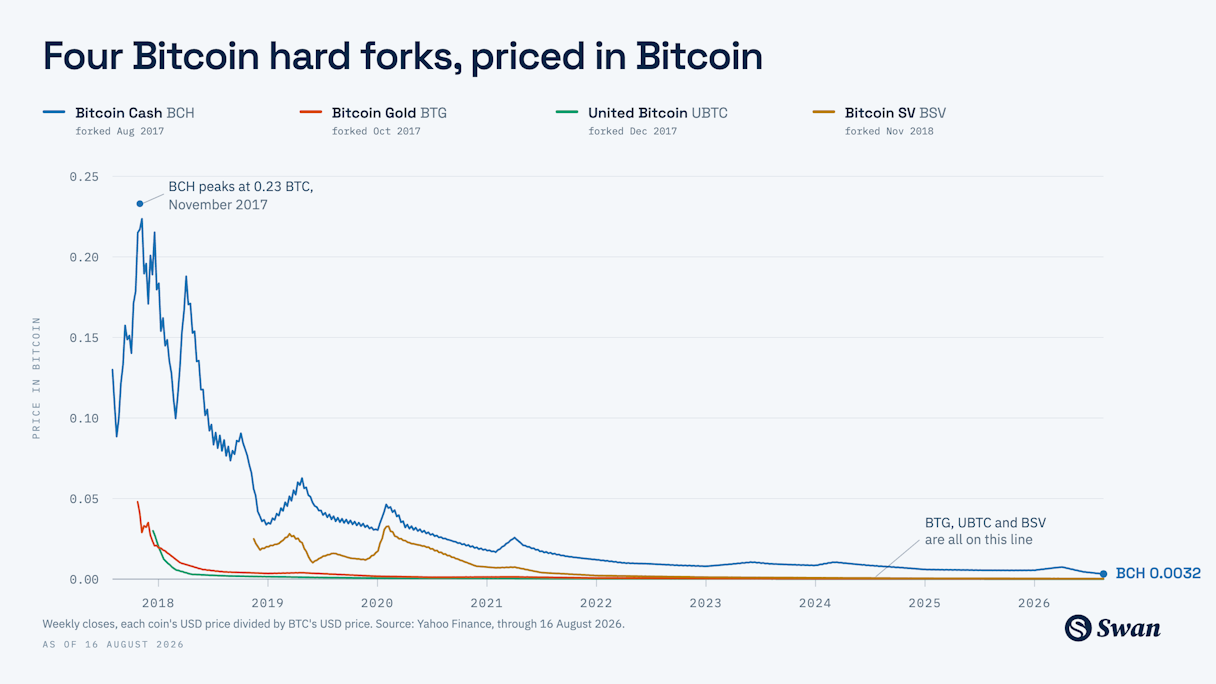
For a few intoxicating weeks, the plan looked like it might work. After a chaotic launch, Bitcoin Cash ripped high enough in November 2017 that believers openly forecast “the flippening,” the moment BCH would dethrone BTC. BCH supporters astroturfed online forums like Reddit and 4chan, claiming that Bitcoin would enter into a ‘mining death spiral as soon as Bitcoin miners saw the light and switched to the BCH chain. On November 12, 2017, BCH briefly ran up to an all-time intraday high of roughly 0.4-0.5BTC.
Then the economic incentives kicked in. Since all users of Bitcoin prior to the fork had received the fork coins as an airdrop, in other words, for free, it stood to reason that selling them for anything above zero would be a win. After pumping BCH to an astronomical value of approximately 0.4BTC, sell them they did. The bleed was slow and relentless. Today Bitcoin Cash trades around $205, roughly 0.0032 BTC, about a third of one percent of a bitcoin.
BCH showed that it was possible to create new value out of thin air and pump-and-dump the coin using Bitcoin affinity marketing. This opened the door for more coins following the same formula. Two months later, Bitcoin Gold (BTG) forked on October 24, 2017, at block 491,407, replacing Bitcoin’s SHA-256 proof-of-work with the Equihash algorithm.
The pitch: Bitcoin mining has been captured by industrial ASIC farms, so let’s make it mineable on ordinary GPUs and “make Bitcoin decentralized again.” Sound familiar? It’s one of the pitches now being used by the upcoming BIP110 / Luke Dashjr coin.
Ironically, by choosing an algorithm with no dedicated mining industry behind it, Bitcoin Gold made itself cheap to attack. In May 2018, it suffered a 51% attack in which an estimated $18 million was double-spent, getting it delisted from Bittrex that September after the Bitcoin Gold team refused to cover part of the exchange’s loss; it was hit again in January 2020.
Bitcoin Gold peaked at roughly 0.068 BTC shortly after launch. Today it trades for pennies, and on many days its 24-hour trading volume is literally zero.
The 2017 bull market taught opportunists a simple trick: fork Bitcoin, “airdrop” a free coin to every holder, list it on a few exchanges, pump it, then cash out. What followed was an explosion of Bitcoin affinity scams. Bitcoin Diamond, Super Bitcoin, Bitcoin God, Bitcoin Private, Lightning Bitcoin, Bitcoin Atom, and more. Dozens of forks, all with near-zero uptake.
Early Bitcoin developer Jeff Garzik, who first proposed a block size increase way back in 2010, only to be rejected by Satoshi himself, launched United Bitcoin (UBTC) on December 12, 2017, promising smart contracts, Lightning support, and 8 MB blocks. In a sick twist, it assigned balances of dormant, inactive wallets (including the dormant Satoshi coins) to a “UB Foundation”. It’s obviously impossible to steal Satoshi’s coins, but if you launch your own version of the ledger, you could do whatever you want. Obviously, nobody wanted to live in that world. Like almost every coin in this wave, it has effectively vanished from the market.
The attempt to steal Satoshi’s dormant coins on a fork recently repeated with another long time Bitcoin personality with ongoing grievances due to the Bitcoin network not adopting his Drivechains technology: Paul Sztorc who announced plans to launch an “eCash” fork of Bitcoin, targeted at August 2026, which would leave 600k of Satoshi’s coins at their original addresses and reassign the remaining 500k to “investors” who fund the project before launch. This fork, like Garzik’s, combined impressive-looking “technology upgrades” with coin reassignment to early investors. Not quite Satoshi’s vision, but I digress.
Strangely, the name eCash is already taken by another fork of BCH, and is confusingly a generic name for a legitimate Bitcoin adjacent technology, Chaumian Ecash, such as that implemented by Cashu. Maybe the confusion is intentional. It makes you wonder.
The most operatic breakaway wasn’t a fork of Bitcoin at all. It was a fork of Bitcoin Cash. By 2018, the Bitcoin Cash camp had its own irreconcilable schism, between Amaury Séchet’s Bitcoin ABC and a faction led by Craig Steven Wright and the billionaire online-gambling magnate Calvin Ayre, who wanted even bigger blocks and a return to what Wright insisted was “Satoshi’s Vision.” On November 15, 2018, at block 556,766, they split off Bitcoin SV (BSV) — the “SV” for Satoshi’s Vision — handing every BCH holder a fresh pile of BSV. The split was fought as a literal “hash war,” two chains burning money to out-mine each other.
No fork leaned harder on a cult of personality, because BSV’s entire premise was a personality: Craig Wright’s claim to be Satoshi Nakamoto himself. In early 2019, Wright began issuing libel threats against anyone who publicly doubted the claim, including the pseudonymous Bitcoiner “Hodlonaut,” on whose identity his camp effectively placed a bounty, plus podcaster Peter McCormack and Ethereum’s Vitalik Buterin. The industry’s response was swift. On April 12, 2019, Binance CEO Changpeng Zhao tweeted, “Craig Wright is not Satoshi. Anymore of this sh! t, we delist!” and Binance, Kraken, and other exchanges cut BSV loose under a #DelistBSV banner, severing much of its liquidity.
BSV’s key moment came in January 2020, when Wright claimed a “bonded courier” had finally delivered the keys to a mythical “Tulip Trust” holding over a million early bitcoins. On that rumor, the price rocketed from about $95 to over $400 in days, briefly overtaking Bitcoin Cash by market cap, before the proof failed to materialize, and it gave everything back. The story ended in a British courtroom: in a March 2024 ruling later expanded into a scorching written judgment, the High Court of England and Wales found that Craig Wright is not Satoshi Nakamoto, did not write the white paper, and had forged documents “on a grand scale.”
The chart followed the prophet. BSV started life worth something like a sixtieth of a bitcoin, spiked to roughly 0.05 BTC in the January 2020 mania, and today trades near $15, or 0.00024 BTC after printing an all-time dollar low of $10.49 on June 25, 2026. Priced against Bitcoin, “Satoshi’s Vision” has lost well over 99% of its value.
The pattern is fractal. Three years after helping fork Bitcoin Cash out of Bitcoin, Amaury Séchet drove another split, this time over an “Infrastructure Funding Plan” that would divert a slice of every block reward to a development fund under his team’s control. Again, a play familiar to those who followed the ideas in United Bitcoin and many other projects.
On November 15, 2020, Bitcoin Cash divided again: the majority rejected the plan and kept the BCH ticker, while Séchet’s minority chain, Bitcoin Cash ABC, limped off on its own and rebranded to eCash (XEC) the following July. The same eCash name is now being claimed by Paul Sztorc’s fork. This BCH eCash also now trades for pennies.
Fast forward to today, August 2026. Many of us have thought the forking days of Bitcoin are over. Didn’t everyone learn their lesson in 2017-2018? Apparently not. What’s driving today’s fork is another presumably aggrieved clan, and another leader with a penchant for saying exceptionally misleading things.
What’s the grievance? It starts with spam. Over the last few years, Bitcoin has started becoming popular for non-monetary use cases. A variety of individuals and companies started popularizing embedding images and other data into the blockchain. The concept of NFT’s (Non-Fungible Tokens) arguably became popularized by Cryptokitties on Ethereum, which went to zero. The idea was to embed various data, such as images, on the blockchain, and then sell those images as “unique” to speculators who hoped to dump them on the next person before the party ran out. And the party did essentially run out. The parallel to Eth’s Cryptokitties was Bitcoin’s Quantum Cats. When they launched, I warned people about their guaranteed demise based on the history of Cryptokitties. This came to pass. After a number of pump and dumps, the Quantum Cats have achieved near-zero trading volume.
Nonetheless, many users of Bitcoin during this time became agitated at the non-monetary use of Bitcoin. Some even became vocally concerned that arbitrary data embedding could lead to the storage of illegal information on Bitcoin (never mind that it is impossible to truly remove all arbitrary data storage from the protocol). This faction, led initially by nym Dathon Ohm and supported by Bitcoin Knots developer Luke Dashjr, started a movement called BIP110, which was a soft fork that would have placed a temporary, twelve-month restriction on certain types of data storage on the chain.
While soft forks are, on the surface, backward compatible (meaning that miners of BIP110 blocks would produce blocks that other nodes would just accept), the BIP110 fork came with an ultimatum. Not only did it restrict the data going into the block, but it also said: “If you miners do not also signal that you are doing this, I will reject your blocks.” This was an attempt to coerce miners to follow the mandate of this group of users, also known as a User Activated Soft Fork (UASF). The logic of this group was that a UASF of this sort was used to game theoretically force miners to comply and activate Segwit back in 2017, so it could be done again.
The miscalculation appeared to be that there was no economic incentive for miners to restrict themselves to processing only certain types of transactions, and that the UASF of 2017 was not the lone factor that encouraged miners to follow the Segwit upgrade. After mandatory signaling opened on August 8, 2026, at block 961,632, roughly 2.5% of blocks signaled for BIP110 against a 55% activation threshold. The BIP110 chain had essentially zero support from any miners except a small group known as Roughnecks, which mined exactly two blocks, 961,632 and 961,633, before the chain stalled out, while Bitcoin continued. The Rougnnecks have since resumed mining, presumably at a very bad loss to themselves, since the coins are not spendable yet.
This led to increasingly erratic rage-quit behavior by Luke Dashjr, who became the leader of a splinter movement to create a hard fork from the BIP110 chain. He started calling the minority fork (the stalled out chain), “Bitcoin”, while referring to the main Bitcoin chain (which has continued unaffected) as “Bpedo” in reference to his allegations that it will be used to distribute CSAM material. He posted that all the miners were “attacking” Bitcoin, where the reality is that the miners were just doing their normal business. He also said that he would hard fork the chain in just about two weeks (Sep 1, 2026). He selected a new mining algorithm (BLAKE2b) by a bizarre cryptographic ceremony that was gameable because it used a test network anyone could control, and which had to be abandoned and restarted once onlookers began producing testnet4 blocks to steer the draw. While BIP110 started out as an attempt to gather consensus, it ended in a faction that decided that they would no longer seek consensus. Their actions will create a new forkcoin.
My prediction for this new fork is that, like other forks before it, it will be used by opportunistic insiders to pump and dump and sell their coins to the unsuspecting “community” that is following them into this disaster. That is, if they convince some exchanges to list it. In a society increasingly driven by nihilistic gambling, I wouldn’t be surprised if even some of the major exchanges pick it up. Unfortunately, the buyers of these coins are going for a one-way ride to zero, driven by millions of Bitcoin owners, sellers who had a cost of zero to acquire the same coins for which the buyers are now paying a non-zero price. I hope that some of them will read this history and avoid making the mistakes that others have made in the past.
Bitcoin holders should be extremely cautious about attempting to claim or sell coins created by contentious Bitcoin forks, particularly when the fork does not provide strong, automatic replay protection. The danger is that the two chains begin with the same coins, keys, and largely the same transaction rules: if you sign a transaction intending to move your fork coins to an exchange to sell them, that transaction may also be valid on Bitcoin and can potentially be rebroadcast there, causing your real BTC to move as well. This will almost certainly lead to irrevocable loss of real Bitcoin.
This is the replay-attack problem, and it means that “free” fork coins can create a risk vastly greater than their market value. Until a fork has demonstrated robust replay protection, reliable coin-splitting procedures, and mature wallet support, holders should generally avoid importing seed phrases or private keys into fork software, avoid signing fork-chain transactions with wallets containing valuable BTC, and treat any instruction to “claim your free coins” as potentially capable of putting the corresponding bitcoin at risk.
The complexity of safely working with forked coins means that typically, the most technically advanced Bitcoiners, who are building their own wallet software early on in the fork game, including the developers of the fork, are accessing their coins first. They are likely going to be the first ones to dump them while new buyers are being marketed to and told that this is the “new Bitcoin” or “real Bitcoin”.
Further, during forks, scammers, including fork insiders, capitalize on the confusion by putting out urgent notices that you have to do something mandatory. This is all entirely false. Doing nothing is the safest move in Bitcoin, and why Bitcoin works as generational wealth that you can leave alone for decades. If you are scammed into doing something urgent like putting your seed phrase into a fake wallet, you will lose your Bitcoin permanently.
Of the roughly some hundred coins that have forked from Bitcoin over the years, all have become dead, irrelevant, thinly traded, and/or abused by opportunistic pump and dumpers and insiders. The takeaway isn’t that the founders didn’t have legitimate (at least in their eyes) technical grievances, or that all of them were motivated by getting rich, wanting a cult following, or outright fraud, though some combination of those factors does seem to be in play for most of the cases. It’s much deeper — it doesn’t matter what your motivation is.
You can fork the code. You can fork the ledger. You can even fork the brand. What you cannot fork is the thing that actually gives Bitcoin its value: the network of people who agree, without being told to, that Bitcoin itself can never change. That is the reason people buy it, trade hard assets like real estate for it, and leave it to their grandchildren. That agreement is the Schelling point, and it doesn’t split when the chain does. It only makes the value proposition of Bitcoin stronger: it is impossible to violate the rules of the Bitcoin protocol and create Bitcoin for free, but it is completely free to create Bitcoin clones outside of the protocol.
Caveat emptor.
Yan Pritzker is the cofounder and CTO of Swan Bitcoin and the author of Inventing Bitcoin.
In this article
Thoughts on Bitcoin from the Swan team and friends.
Unlike a stock split, the new shares still refer to the original company; a Bitcoin fork creates new assets out of thin air at zero cost and grifts them to existing holders. A fork does not affect the 21M supply limit.
The Blocksize Wars were “fought”… but by whom? And what do we really mean by fighting?
For Bitcoin to achieve the lofty goals many have for it, its rules will need to change. This three-part series of articles will tackle what it takes to change Bitcoin.