








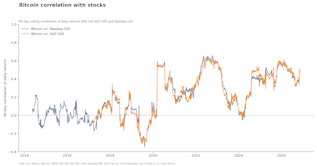
Bitcoin Correlation With Stocks: S&P 500 & Nasdaq Data


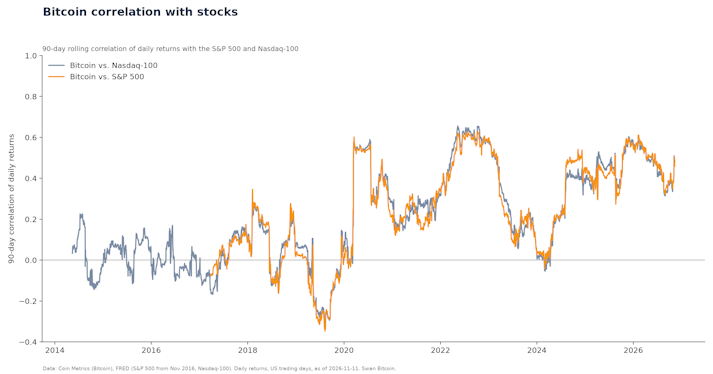
Bitcoin’s correlation with the S&P 500 was 0.42 in 2025 and 0.46 over the last 90 days (Nov 2026). Yearly data since 2017, Nasdaq, dollar and crash days.
In this article
MSTR is the stock of Strategy Inc., the company formerly called MicroStrategy, which held 850,364 BTC as of November 8, 2026. GBTC is the Grayscale Bitcoin Trust ETF, a spot Bitcoin ETF that charges 1.50% a year. GBTC follows the Bitcoin price minus its fee. MSTR has swung much more than Bitcoin, because the company borrows and issues stock to buy more. Neither one gives you Bitcoin you can withdraw. All figures below are dated; Swan doesn’t predict prices, and this comparison isn’t investment advice.
What you own: MSTR is a share of an operating company. GBTC is a share of a trust that holds Bitcoin.
Bitcoin behind it: MSTR, 850,364 BTC (Strategy 8-K, November 8). GBTC, 123,694 BTC (Bitbo, November 11).
Annual fee: MSTR has no fund fee. GBTC charges 1.50% a year.
Size: MSTR market cap $51.24 billion. GBTC assets $9.37 billion (StockAnalysis).
How closely it follows Bitcoin: GBTC tracks the value of its Bitcoin. MSTR can trade above or below the value of its Bitcoin.
52-week price range: MSTR $81.81 to $239.24, a high 2.9 times its low. GBTC $44.98 to $82.14, a high 1.8 times its low (StockAnalysis).
Can you withdraw Bitcoin? No, for both. You own shares, not Bitcoin.
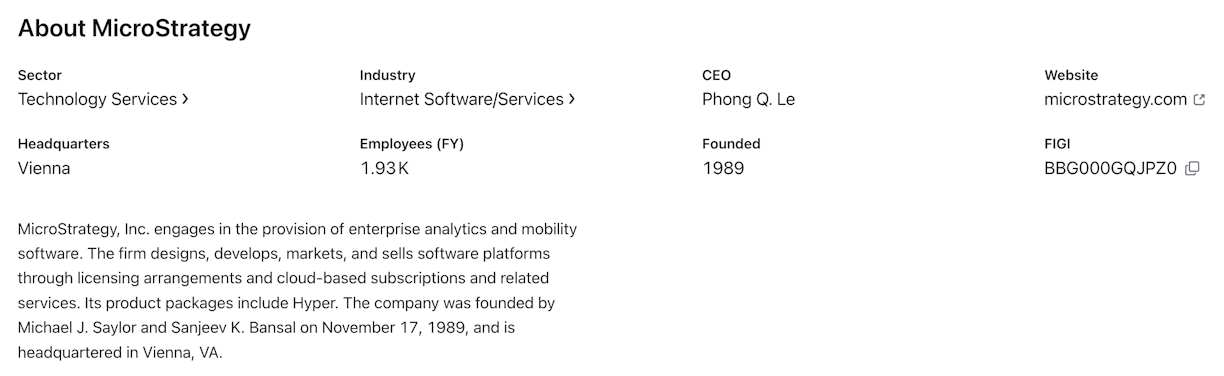
MSTR is the Nasdaq ticker of Strategy Inc., a business-intelligence software company that has made Bitcoin its main treasury asset. It traded as MicroStrategy until 2025; SEC records list “MicroStrategy Inc” as its former name until August 11, 2025. Michael Saylor co-founded the company in 1989, and it first bought Bitcoin in August 2020.
Tradingview
As of November 8, 2026, Strategy held 850,364 BTC, bought for $64.16 billion in total, an average of $75,456 per Bitcoin including fees, according to its November 9 filing. The software business is small next to that: trailing 12-month revenue was $495 million (StockAnalysis).
How Strategy pays for its Bitcoin. It sells new MSTR shares and several classes of preferred stock (STRF, STRC, STRK and STRD) through at-the-market programs, and it has issued convertible debt. In the week of November 2 to 8, 2026, it sold 2,051,348 MSTR shares for $283.8 million and bought 1,036 BTC for $81.9 million. It also keeps a $4.77 billion U.S. dollar reserve “intended to support the payment of dividends on Strategy’s preferred stock” and interest on its debt (same filing). Learn more about the company’s thinking in our takeaways from the MicroStrategy World conference.
mNAV compares what the market pays for Strategy with the value of the Bitcoin it holds. A simple version on November 11, 2026:
Bitcoin held: 850,364 BTC × about $74,470 (Bitbo) = about $63.3 billion
MSTR market cap: $51.24 billion (StockAnalysis)
Market cap divided by Bitcoin value: about 0.81
That simple ratio leaves out Strategy’s debt and preferred stock, which rank ahead of common shareholders. Strategy’s own mNAV uses enterprise value, which adds them, so its figure is higher. The ratio matters because selling new shares adds Bitcoin per share only when the shares trade above the value of the Bitcoin behind them.
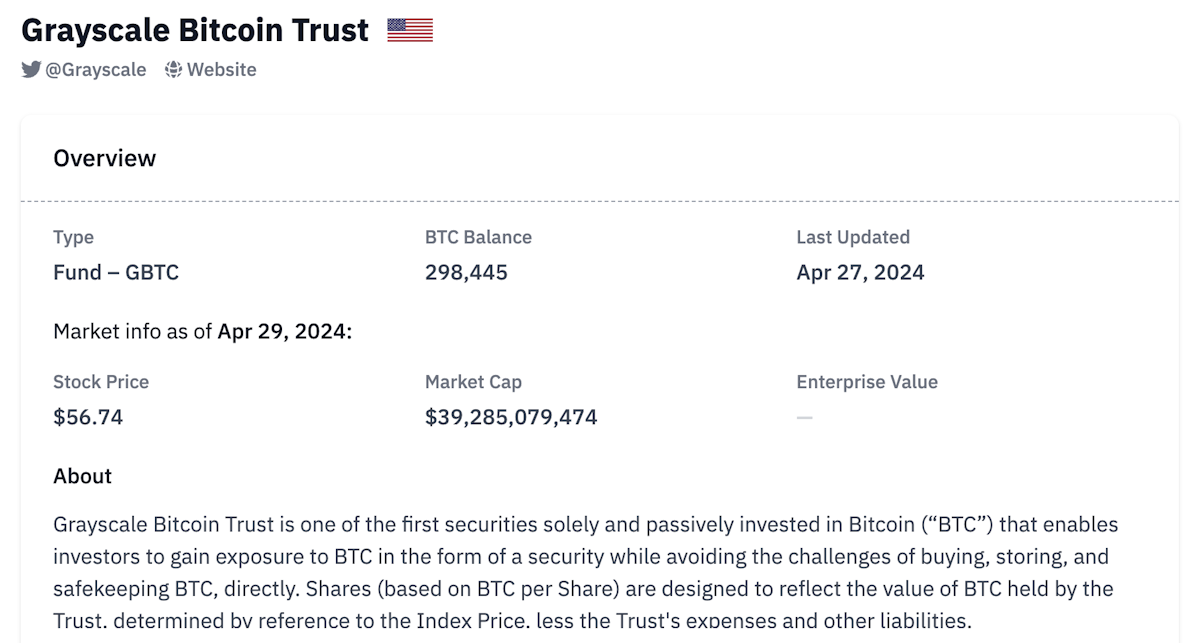
GBTC is the Grayscale Bitcoin Trust ETF, a spot Bitcoin ETF listed on NYSE Arca. It holds Bitcoin and charges a 1.50% annual fee, the highest of the U.S. spot Bitcoin ETFs (see our Bitcoin ETF fees comparison). Grayscale ran it as a trust that traded over the counter until January 11, 2024, when it converted to an ETF alongside the other spot funds that launched that day.
Bitcoin Treasuries
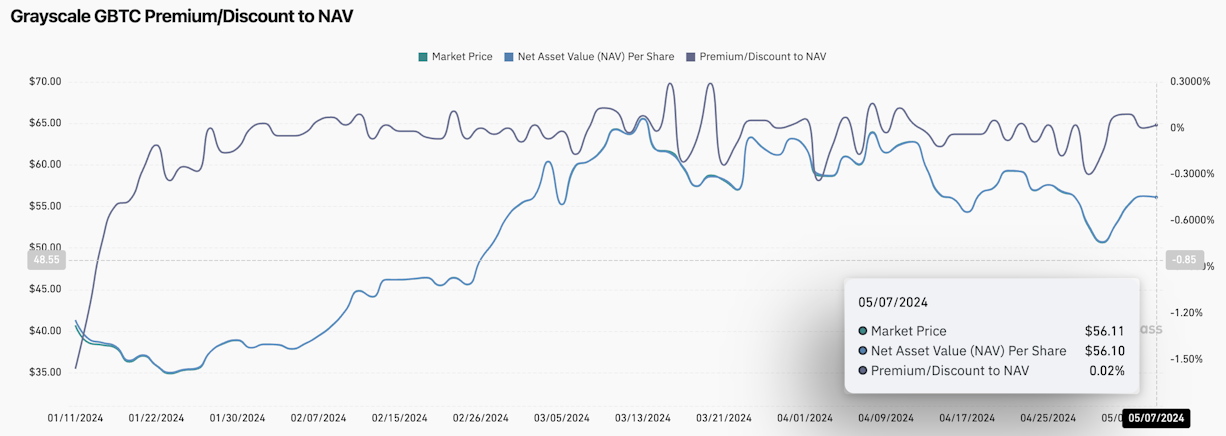
The discount is gone. As a closed trust, GBTC could not create or redeem shares, so its price drifted far from the value of its Bitcoin, at times to a deep discount. That premium trade played a part in the 2022 credit contagion (part II). Since becoming an ETF, GBTC creates and redeems shares, and its price has generally stayed close to its net asset value.
CoinGlass
GBTC has a cheaper sibling. The Grayscale Bitcoin Mini Trust ETF (ticker BTC) launched on July 31, 2024, with a 0.15% fee. Grayscale seeded it with 10% of GBTC’s Bitcoin (Grayscale). On November 11, 2026, it held 62,259 BTC (Bitbo) and $4.72 billion in assets (StockAnalysis).
The fee gap shows up in returns. Over the past year, GBTC returned −30.96% and the Mini Trust −29.99% (StockAnalysis, November 11, 2026). Same Bitcoin, same sponsor: the difference of about one percentage point is mostly the fee. For other comparisons, see GBTC vs. FBTC, IBIT vs. GBTC and BITO vs. GBTC.
Fees are taken out of the Bitcoin behind your shares every year, so they compound. Here is the share of that Bitcoin each option takes in fees over 10 years, ignoring price changes and brokerage commissions:
GBTC (1.50% a year): about 14.0% of the Bitcoin behind your shares.
Grayscale Bitcoin Mini Trust (0.15% a year): about 1.5%.
MSTR: no fund fee. The costs come in other forms: new shares that dilute you when they sell below the value of the Bitcoin, interest on debt, and dividends on preferred stock.
Buying Bitcoin at Swan and holding it in self-custody: 1%, paid once. Swan charges 1% on buys and sells, $0 to withdraw, and $0 to hold Bitcoin in self-custody (Swan fees page).
Method: 1 − (1 − annual fee)^10. Fees as published on November 11, 2026.
MSTR risks:
Leverage and bigger swings. Strategy’s debt and preferred stock rank ahead of common shareholders. Over the past 52 weeks MSTR’s high was 2.9 times its low, against 1.8 times for GBTC.
Dilution. Strategy funds purchases by selling new shares. That adds Bitcoin per share only while MSTR trades above the value of its Bitcoin.
Company decisions. You rely on management’s choices about when to buy, borrow or issue shares.
Earnings swings. Strategy’s reported profit moves with the Bitcoin price. Trailing 12-month net income was −$14.89 billion (StockAnalysis).
GBTC risks:
Fee drag. 1.50% a year is ten times the fee on Grayscale’s own Mini Trust.
Custodian and issuer. A third party holds the Bitcoin, and you can’t redeem shares for it.
Bitcoin’s price. GBTC falls as much as Bitcoin does, plus the fee.
It depends on what you want to own. GBTC is a simple way to track the Bitcoin price in a brokerage account, at a high fee; the Mini Trust does the same at a tenth of the cost. MSTR is a bet on Bitcoin plus Strategy’s use of debt and stock sales, so it can rise or fall much more than Bitcoin. Neither gives you Bitcoin you hold yourself.
Both MSTR and GBTC give you a claim on Bitcoin someone else holds. Buying Bitcoin directly means you can withdraw it to your own wallet and hold the keys. For the full argument, read buy real Bitcoin, not a Bitcoin ETF and why every investor should have Bitcoin in their portfolio. Swan is Bitcoin only.
At Swan Bitcoin, you buy real Bitcoin:
1% on buys and sells, $0 withdrawals, and $0 to hold in self-custody
Real Bitcoin in a retirement account with the Swan Bitcoin IRA
Collaborative multisig cold storage with Swan Vault
Swan Private for larger accounts
Hold your IRA with the most trusted name in Bitcoin.
Yes. MicroStrategy now operates as Strategy Inc. and still trades under the ticker MSTR. SEC records list MicroStrategy Inc as its former name until August 11, 2025.
850,364 BTC as of November 8, 2026, bought for $64.16 billion at an average of $75,456 per Bitcoin, according to its November 9, 2026 SEC filing.
GBTC charges 1.50% a year. Grayscale’s Bitcoin Mini Trust ETF (BTC) charges 0.15%.
No. GBTC became an ETF on January 11, 2024. Since then it creates and redeems shares, and its price has generally stayed close to the value of its Bitcoin.
mNAV compares Strategy’s market value with the value of its Bitcoin. On November 11, 2026, its market cap ($51.24 billion) was about 0.81 times the value of its Bitcoin (about $63.3 billion). Strategy’s own mNAV adds debt and preferred stock, so it is higher.
Brokerage IRAs can usually hold both, since they trade like stocks. Neither gives you Bitcoin you control. The Swan Bitcoin IRA holds real Bitcoin.
By price swings, yes. Over the past 52 weeks, MSTR’s high was 2.9 times its low ($81.81 to $239.24), against 1.8 times for GBTC ($44.98 to $82.14). Strategy’s debt, preferred stock and share sales add risks that a Bitcoin ETF doesn’t have.
Strategy Inc., Form 8-K filed November 9, 2026 (holdings, purchase price, share sales, USD reserve)
SEC EDGAR, Strategy Inc company filings (former name)
StockAnalysis, MSTR, GBTC and BTC Mini Trust (November 11, 2026)
Bitbo, Bitcoin held by U.S. ETFs (November 11, 2026)
Grayscale, What is the Grayscale Bitcoin Mini Trust?
Swan, fees page, swanbitcoin.com/fees (November 11, 2026)
Swan doesn’t predict prices, and this article isn’t investment advice. Figures are as of the dates shown and change daily.
Drew, a class of 2013 Bitcoiner, is a Research Analyst for Swan Bitcoin.
He has worked in institutional VC/PE, FinTech, and DLT consulting for over six years. He also brings over twelve years of experience working with national nonprofits and start-ups in education and software development in several leadership roles.
Thoughts on Bitcoin from the Swan team and friends.
Bitcoin’s correlation with the S&P 500 was 0.42 in 2025 and 0.46 over the last 90 days (Nov 2026). Yearly data since 2017, Nasdaq, dollar and crash days.
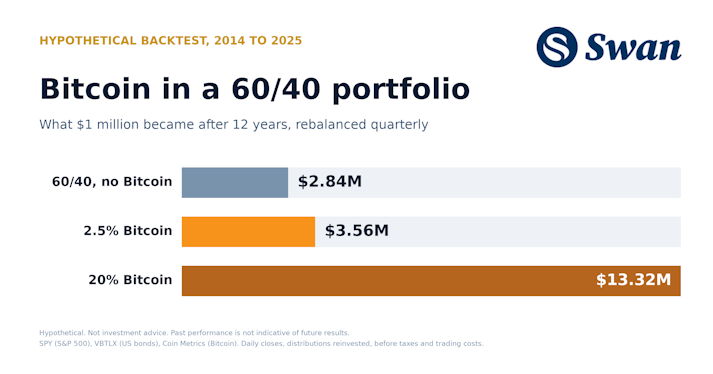
How much Bitcoin to hold in a 60/40 portfolio: 2.5% lifted annual returns from 9.1% to 11.2% (2014–2025). Results from 1% to 20%, drawdowns and method.
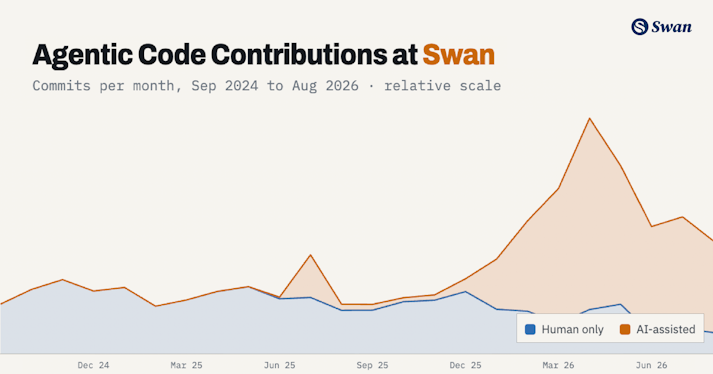
How Swan built an agentic software factory that finds production bugs, reaches consensus on the fix, opens the PR, and proves it works before a human merges.