


Bitcoin Correlation With Stocks: S&P 500 & Nasdaq Data


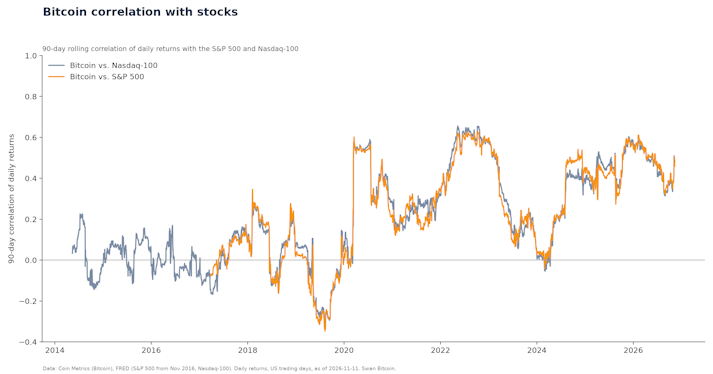
Bitcoin’s correlation with the S&P 500 was 0.42 in 2025 and 0.46 over the last 90 days (Nov 2026). Yearly data since 2017, Nasdaq, dollar and crash days.
In this article
A mega backdoor Roth lets you put after-tax 401(k) money into a Roth account, up to the 2026 total plan limit of $72,000, if your plan allows it. A regular backdoor Roth IRA adds up to $7,500 a year ($8,600 at age 50 or older) for people who earn too much to contribute to a Roth IRA directly. Both strategies are still legal in 2026, and the 2025 tax law left them in place. This guide covers the 2026 limits, how each strategy works, the pro-rata and five-year rules, and the risks.
These are the IRS figures for 2026, announced November 13, 2025 (IR-2025-111), with 2025 for comparison:
IRA contribution limit (traditional or Roth): $7,500 (2025: $7,000)
IRA catch-up, age 50 and older: $1,100, for a total of $8,600 (2025: $1,000)
Roth IRA income phase-out, single and head of household: $153,000 to $168,000 (2025: $150,000 to $165,000)
Roth IRA income phase-out, married filing jointly: $242,000 to $252,000 (2025: $236,000 to $246,000)
Roth IRA income phase-out, married filing separately: $0 to $10,000 (not adjusted for inflation)
401(k) employee deferrals (pre-tax or Roth): $24,500 (2025: $23,500)
401(k) catch-up, age 50 and older: $8,000; $11,250 instead for ages 60 to 63
Total 401(k) limit, all contributions combined: $72,000 (2025: $70,000)
Source for the plan limits: the IRS COLA table.
A mega backdoor Roth is a two-step strategy: you make after-tax contributions to your 401(k), then convert that money to a Roth 401(k) or roll it to a Roth IRA. Fidelity describes it the same way, and notes that not every plan allows both steps.
It works because a 401(k) has two separate limits. The $24,500 limit covers your own pre-tax and Roth deferrals. The $72,000 limit covers everything that goes into the plan in a year: your deferrals, your employer’s contributions and any after-tax contributions. After-tax contributions are a third type, different from both pre-tax and Roth deferrals, and they can fill the gap between the two limits.
Once the after-tax money is in the plan, you move it into a Roth:
In-plan Roth conversion: the after-tax balance is converted to the plan’s Roth 401(k).
Rollover to a Roth IRA: the plan pays out the after-tax contributions and you roll them to a Roth IRA. Fidelity notes that the earnings on those contributions can go to the Roth IRA, where they are taxed, or to a traditional IRA, where they are not taxed yet.
Either way, the contributions themselves were already taxed. You owe income tax only on the earnings they made before the conversion, so converting soon after each contribution keeps the tax bill small.
Your after-tax room for 2026 is $72,000 minus your own deferrals minus your employer’s contributions. For ages 50 to 59 and 64 or older, Fidelity puts the combined total at $80,000 including catch-up contributions, and $83,250 for ages 60 to 63 if the plan allows the higher catch-up.
Worked example (under age 50, 2026 limits):
Your Roth 401(k) deferrals: $24,500
Your employer’s matching contributions: $8,000
After-tax room: $72,000 − $24,500 − $8,000 = $39,500
Add a backdoor Roth IRA contribution: $7,500
New Roth money for 2026: $24,500 + $39,500 + $7,500 = $71,500
That is more than nine times the $7,500 a person under the income limits can put straight into a Roth IRA. The employer’s $8,000 match usually goes in pre-tax, so it is not counted as Roth money here.
Only your plan documents can answer this. The strategy needs a plan that:
Accepts after-tax contributions above the $24,500 deferral limit.
Lets you move them into a Roth: either an in-plan Roth conversion or in-service withdrawals that you can roll to a Roth IRA while you still work there. Fidelity notes that many plans do not permit in-service withdrawals.
Ask your plan administrator for the summary plan description, and check whether after-tax contributions earn an employer match. Fidelity says that depends on the plan. If you change jobs, the new plan’s rules may be different.
The two strategies use different accounts, and many high earners use both in the same year:
Where it happens: a mega backdoor Roth uses your 401(k) or other workplace plan. A backdoor Roth IRA uses a traditional IRA and a Roth IRA.
2026 maximum: a mega backdoor Roth can use whatever is left of the $72,000 plan limit. A backdoor Roth IRA is capped at $7,500, or $8,600 at age 50 or older.
Who can use it: a mega backdoor Roth needs an employer plan with the features above. A backdoor Roth IRA only needs earned income, at any income level.
Main tax trap: for a mega backdoor Roth, tax on earnings before conversion. For a backdoor Roth IRA, the pro-rata rule (below).
Paperwork: for a mega backdoor Roth, your plan sends Form 1099-R for the distribution or conversion. For a backdoor Roth IRA, you file Form 8606 with your tax return.
A backdoor Roth IRA is a way for people over the Roth IRA income limits to fund a Roth IRA anyway: you make a nondeductible contribution to a traditional IRA, then convert it to a Roth IRA. The income limits apply to Roth IRA contributions, not to conversions, so the two steps together get the money into a Roth.
With a Roth IRA, you contribute money you have already paid tax on, and qualified withdrawals in retirement, including the growth, are tax-free. With a traditional IRA, contributions may be deductible, and withdrawals are taxed as ordinary income.
For 2026, you can make a full Roth IRA contribution if your modified adjusted gross income (MAGI) is below $153,000 (single or head of household) or $242,000 (married filing jointly). Inside the phase-out range, $153,000 to $168,000 or $242,000 to $252,000, the amount you can contribute shrinks. At $168,000 or $252,000 and above, you cannot contribute directly at all. IRS Publication 590-A explains how to calculate MAGI and a reduced contribution.
These limits do not apply to Roth conversions. That has been true since 2010.
The Tax Increase Prevention and Reconciliation Act of 2005 (TIPRA), which became law on May 17, 2006, removed the income limit on Roth conversions starting in 2010.
Congress.gov
Before 2010, only people with modified adjusted gross income of $100,000 or less could convert a traditional IRA to a Roth IRA. Since 2010, anyone can convert, at any income. That change is what makes the backdoor Roth IRA possible: high earners can’t contribute to a Roth IRA directly, but they can contribute to a traditional IRA and convert it.
Check your other IRA balances first. If you hold pre-tax money in any traditional, SEP or SIMPLE IRA, the pro-rata rule (next section) can make most of your conversion taxable.
Make a nondeductible contribution to a traditional IRA. For 2026, that is up to $7,500, or $8,600 at age 50 or older. You can make contributions for 2026 until the tax filing deadline, April 15, 2027.
Convert the traditional IRA to a Roth IRA. The contribution itself isn’t taxed again. Any earnings before the conversion are taxable, so many people convert soon after contributing.
File Form 8606 with your tax return. It reports the nondeductible contribution and the conversion. Skipping it can mean paying tax twice on the same money.
Repeat each year. The backdoor works one year at a time, so it only adds up if you do it every year.
A backdoor Roth IRA can hold Bitcoin. The Swan Bitcoin IRA offers both Traditional and Roth IRAs and accepts contributions by wire. Swan’s 401(k) rollover guide says it is generally best to roll into a Traditional IRA first and then do the Roth conversion inside the Swan IRA.
The pro-rata rule means you can’t convert only your after-tax IRA money. The IRS treats all your traditional, SEP and SIMPLE IRAs as one account, and each conversion is taxable in proportion to the pre-tax share of that total, based on your balances at the end of the year (Form 8606).
Example: you have $92,500 of pre-tax money in a rollover IRA and add a $7,500 nondeductible contribution, for $100,000 in total. Only 7.5% of the total is after-tax. If you convert $7,500, just $562.50 is tax-free and $6,937.50 is taxable.
The fix, sometimes called the escape hatch: if your employer’s 401(k) accepts roll-ins, you can move the pre-tax IRA money into the 401(k) before the end of the year. Your IRAs then hold only after-tax money, and the conversion is almost entirely tax-free.
There are two separate five-year rules, explained in IRS Publication 590-B:
For each conversion: if you are under 59½, withdrawing converted money within five years of that conversion can trigger the 10% additional tax. Each year’s conversion starts its own five-year clock.
For earnings: earnings come out tax-free only in a qualified distribution, which generally means you are 59½ or older and at least five years have passed since your first Roth IRA contribution or conversion.
Your own contributions can come out at any time without tax or penalty.
No. As of November 2026, both the backdoor Roth IRA and the mega backdoor Roth are still allowed. The One Big Beautiful Bill Act, signed July 4, 2025, did not eliminate them. A January 2026 analysis by KLR says “final legislation left these tools intact.”
They have been targeted before. President Biden’s fiscal 2025 budget, released March 11, 2024, proposed to “prevent excessive accumulations by high-income taxpayers in tax-favored retirement accounts,” which PlanAdviser reported would eliminate backdoor Roth conversions. Congress never enacted it.
Fidelity’s view today: “While Congress has considered placing limits on backdoor Roth conversions, current retirement legislative efforts have focused on the benefits of contributing to a Roth, rather than conversions.”
The longer-term risk is a wealth tax that reaches retirement accounts. Bruce Willey, JD, CPA, founder of American Tax and Business Planning, wrote in Kiplinger in January 2024 that taxes labeled “billionaire wealth taxes” “could easily and quickly expand into retroactive taxes on unrealized and untaxed Roth IRA accounts.” He added: “No one in elected office is currently proposing that kind of retirement account raid.”
Advantages:
Tax-free growth. Qualified withdrawals, including all the growth, are tax-free.
No required minimum distributions for the owner. Traditional IRAs and 401(k)s require withdrawals starting at age 73. Roth IRAs, and designated Roth accounts in 401(k) and 403(b) plans, have none while the owner is alive (IRS).
Tax diversification. Holding both pre-tax and Roth money lets you choose which to draw from in retirement, depending on your tax bracket.
Estate planning. A surviving spouse can treat an inherited Roth IRA as their own. Other beneficiaries do have to follow the required minimum distribution rules. See our guide to Bitcoin estate planning.
Disadvantages:
Possible tax bill. Pre-tax IRA money (pro-rata rule) and earnings before conversion are taxed as ordinary income, which can push you into a higher bracket that year.
More paperwork. Form 8606 every year for the IRA version, and plan-specific steps for the 401(k) version.
Not every plan allows the mega backdoor.
The rules could change. Congress has proposed limits before.
A Roth account matters most for assets you expect to grow, because qualified withdrawals of growth are tax-free. Peter Thiel’s $5 billion Roth IRA is the best-known example of what tax-free growth can do. For the case for holding Bitcoin in retirement accounts, see why Bitcoin is the ultimate asset for your IRA. To compare providers, see our guide to the best Bitcoin IRAs and our comparison of IRA providers that offer Bitcoin.
Get advice from a tax professional before converting. The right choice depends on your current and expected tax brackets, your other IRA balances and your plan’s features.
Hold your IRA with the most trusted name in Bitcoin.
The total 401(k) limit for 2026 is $72,000, including your deferrals and your employer’s contributions. Your after-tax room is $72,000 minus both. With $24,500 in deferrals and an $8,000 match, that leaves $39,500.
The phase-out range is $153,000 to $168,000 for single filers and heads of household, $242,000 to $252,000 for married couples filing jointly, and $0 to $10,000 for married filing separately.
Yes. It combines two legal steps, a nondeductible traditional IRA contribution and a Roth conversion, and conversions have had no income limit since 2010. The 2025 tax law did not change that.
You can make the traditional IRA contribution for 2026 until the tax filing deadline, April 15, 2027. The conversion counts in the tax year in which you do it.
You can, but the pro-rata rule counts pre-tax money in all your traditional, SEP and SIMPLE IRAs, so part of the conversion will be taxable. Rolling that money into a 401(k) that accepts roll-ins before year-end avoids this.
Roth 401(k) deferrals count toward the $24,500 employee limit. A mega backdoor Roth uses after-tax contributions above that limit, up to the $72,000 total, and then converts them to Roth.
Yes. Some IRA providers hold real Bitcoin. The Swan Bitcoin IRA offers Traditional and Roth IRAs, and conversions can be done inside the Swan IRA.
IRS, IR-2025-111: 401(k) limit increases to $24,500 for 2026, IRA limit increases to $7,500 (November 13, 2025)
IRS, COLA increases for dollar limitations on benefits and contributions
IRS, Publication 590-A and Publication 590-B
IRS, About Form 8606
Fidelity, What is a mega backdoor Roth? (2026 limits)
Fidelity, Backdoor Roth IRA
KLR, Backdoor Roth IRAs for high-income earners: are they still allowed? (January 27, 2026)
PlanAdviser, Biden budget would eliminate backdoor Roth conversions (March 2024)
Kiplinger, How a backdoor Roth IRA works (and its drawbacks) (January 13, 2024)
Congress.gov, H.R.4297, Tax Increase Prevention and Reconciliation Act of 2005
This article is provided for educational purposes only, and cannot be relied upon as tax, accounting, legal, investment, or other advice. Past performance is not indicative of future performance. Bitcoin is a young, volatile, risky asset, and sudden large and sustained drops in price may occur from time to time.
Swan makes no representations regarding the performance, tax consequences, or investment suitability of any structure described herein, and all such questions should be directed to a relevant advisor of your choice.
The Bitcoin Retirement Calculator is only intended to show the projected investment performance based on parameters set by you, and in using this tool, you acknowledge that the results generated by placing various parameters through this tool are only projections of hypothetical performance that may be useful in assisting you in deciding how best to potentially incorporate a Bitcoin allocation in your IRA.
For more information, please visit swan.com.
Matt Ruby is a seasoned content writer helping educate million worldwide about Bitcoin for Swan. Matt work with tech companies to create words, videos, and other content that makes them seem human. He specializes in taking boring/drab tech topics and making them interesting, educational, funny, and accessible to regular people.
In this article
Thoughts on Bitcoin from the Swan team and friends.
Bitcoin’s correlation with the S&P 500 was 0.42 in 2025 and 0.46 over the last 90 days (Nov 2026). Yearly data since 2017, Nasdaq, dollar and crash days.
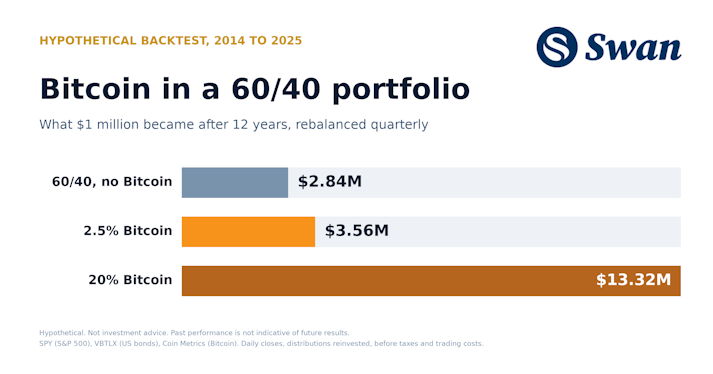
How much Bitcoin to hold in a 60/40 portfolio: 2.5% lifted annual returns from 9.1% to 11.2% (2014–2025). Results from 1% to 20%, drawdowns and method.
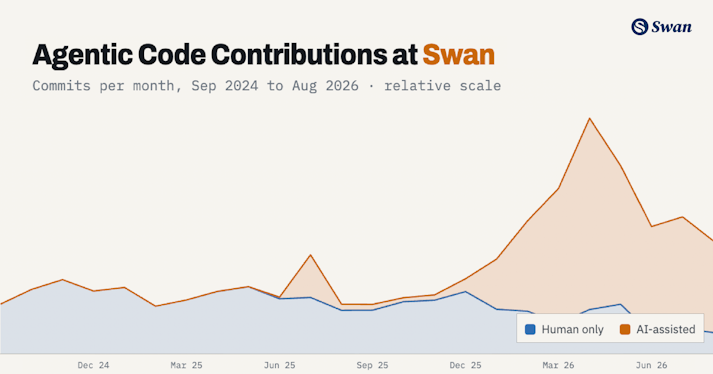
How Swan built an agentic software factory that finds production bugs, reaches consensus on the fix, opens the PR, and proves it works before a human merges.